Ben Uri Pre-Eminent Collection

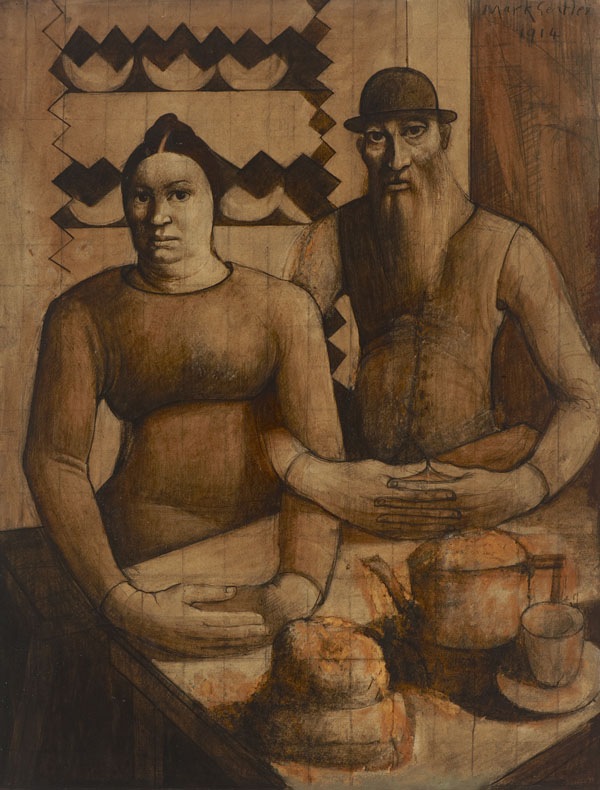
Rabbi and Rabbitzin
Artist information
Born Spitalfields, London, England
Died Hampstead, London, England
Find more work in the collection by this artist
Find out more about this artist
Mark Gertler was born the fifth and youngest child of Austrian-Jewish immigrant parents in Spitalfields, London, England on 9 December 1891. During a period of economic downturn, the family was repatriated to Przemyśl, Galicia, then in the Austro-Hungarian empire (now Southern Poland), the following year. After his father's departure to seek work in America, the family lived on the brink of starvation until eventually they were reunited in London in 1896. Following a brief apprenticeship at Clayton and Bell stained-glass makers, and evening classes at the Regent School Polytechnic, Gertler entered the Slade School of Fine Art in 1908, with a loan from the Jewish Education Aid Society; twice winning the Slade scholarship and leaving with another from the British Institution in 1911. He began exhibiting while still a student with Vanessa Bell's Friday Club in 1910, had a joint show with John Currie at the Chenil Galleries, Chelsea in 1912, and began showing with the New English Art Club the same year. In 1914 his work was included in the so-called 'Jewish Section', co-curated by Bomberg and Jacob Epstein at the exhibition ‘Twentieth Century Art: A Review of Modern Movements’ at the Whitechapel Art Gallery. He was turned down for military service during the First World War, firstly on the grounds of his 'Austrian' parentage, then later, after being called up in 1918 was excused active service on the grounds of ill health and not forced to publicly declare his pacifist convictions, which were instead expressed in his anti-war painting Merry-Go-Round (1916, Tate). Although offered a commission as a war artist, after an attack of depression, he left it unfulfilled.
Gertler was a leading member of the London Group from 1915 onwards, exhibited with Roger Fry’s Omega Workshop in 1917 and 1918 and participated regularly in the Goupil Salons (1915-37). He had five solo shows at the Goupil Gallery, London (1921, 1922, 1923, 1924 and 1926), but tuberculosis, first diagnosed in 1920, seriously undermined his health, frequently confining him to sanatoria: from November 1920 until May 1921, and then again, in 1925, 1929 and 1936. He had six further solo shows in his final decade: at the Leicester Galleries, London (1928, 1930, 1932 and 1934) and at the Lefevre Galleries, London in 1937 and 1939; from 1934, until its closure on the eve of the Second World War, he also taught part-time at the Westminster School of Art. In 1934 and 1937 his work was also included in group shows at the Ben Uri Gallery.
Suffering from ill health and depression, Gertler committed suicide on 23 June 1939. Memorial exhibitions were held at the Leicester Galleries in 1941, Ben Uri Gallery in 1944 and Whitechapel Art Gallery in 1949. Posthumous solo exhibitions have been held at The Minories, Colchester, and tour (1971), Camden Arts Centre (1992), and Ben Uri Gallery, London (1982, 2002 and 2019), with a further show at Piano Nobile Gallery (2012) and a Tate room display in 2018. His work is held in more than 40 UK collections including the Ben Uri Collection, the British Museum, the National Portrait Gallery, Southampton City Art Gallery, the Tate and the V&A.
Object Details
Date 1914
Object type drawing
Medium watercolour and pencil on paper
Materials and techniques pencil | watercolour (medium) drawing (technique) paper (support)
Unframed 48.8 x 37.6 cm
Framed 83 x 71.5 x 4 cm
Signed and dated (upper right): Mark Gertler 1914
Acquisition Acquired in 2002 by private treaty through Sotheby's with the assistance of Art Fund, HLF, V&A/MLA Purchase Grant Fund, Pauline and Daniel Auerbach, Sir Michael and Lady Heller, Agnes and Edward Lee, Hannah and David Lewis, David Stern, Laura and Barry Townsley, Della and Fred Worms and anonymous donors
Accession number 2002-104
Display status not on display
Three years out of the Slade, Gertler’s work became increasingly experimental. 'Rabbi and Rabbitzin', executed on the eve of the First World War, captures the tension between the traditional way of life depicted and the incipient warfare which threatens to overwhelm it. The concentrated, almost claustrophobic domestic interior with the scrubbed kitchen table and simple meal typify Jewish East End life of the period. The simplification of the figures and the still life objects seen from different viewpoints reflect Gertler’s awareness of Cézanne, while the treatment of the dresser and crockery shows the influence of Cubism. The presence of a grid (common Slade practice for squaring up the picture for transfer to canvas) indicates that Gertler planned a painting of the composition. A companion drawing, Rabbi and Rabbitzin with Fish is in the British Museum.
The focus of the work is the relationship between the man and wife – without the title we would not know they are Rabbi and Rebbetzin – yoked together and anchored to their spartan surroundings. Their huge eyes increase their emotive appeal, while their enlarged hands, as in Gertler’s Portrait of the Artist’s Mother (1913, Glynn Vivian, Swansea), indicate suffering and a life that has known hardship. The picture, as a contemporary reviewer noted, also evokes the wider history of the Jewish diaspora: ‘A man and a woman with all the history of an oppressed people behind them […] the incisive and unflinching design […] controlled without loss to their humanity’.
Keywords
bread | diaspora | East End | food | hands | identity | immigrants | Jewish | kitchen | man | painting | portrait | rabbi | rabbitzin | rebbetzin | table | wife | woman
Selected exhibition history
1915
New English Art Club (53rd exhibition)
New English Art Club
1927
Meisterwerke Englische Malerei aus drei Jahrhunderten
Galleries of the Secession
1941
The Mark Gertler Memorial Exhibition
Leicester Galleries
1949
Mark Gertler: Memorial Exhibition
Whitechapel Art Gallery
1971
Mark Gertler 1891-1939
The Minories, Colchester
1983
The Immigrant Generation: Jewish Artists in Britain, 1900-45
Jewish Museum New York
1992
Mark Gertler: Paintings and Drawings
Camden Arts Centre
2002
Mark Gertler: A New Perspective
Ben Uri Gallery - The London Jewish Museum of Art
2003
Director's Choice: Highlights from the Ben Uri Permanent Collection
Ben Uri Gallery - The London Jewish Museum of Art
2003
The Search for Identity: Immigrant Artists in Early Twentieth-century British art
Doncaster Museum and Art Gallery
2006
Recent Acquisitions 2001-2006
Ben Uri Gallery - The London Jewish Museum of Art
2006
Jewish Artists in Britain Celebrating the 350
Arts Depot
2009
Homeless & Hidden 1: World Class Collection Homeless & Hidden
Ben Uri Gallery
2009
Whitechapel Boys
Whitechapel Art Gallery
2009
Sir Muirhead Bone: Artist & Patron
The Fleming Collection
2010
Apocalypse: unveiling a lost masterpiece by Marc Chagall and 50 selected masterworks from the Ben Uri Collection
Osborne Samuel
2013
Selected Highlights from over 200 works acquired during 2003-2013
Ben Uri Art Gallery
2015
Out of Chaos – Ben Uri: 100 Years in London
Somerset House
2016
100 for 100: Ben Uri Past, Present & Future
Christie's South Kensington
2018
Exodus: masterworks from the Ben Uri Collection
Bushey Museum
2018
Acquisitions and Long-Term Loan Highlights Since 2001
Ben Uri Gallery
2018
Mark Gertler: A Journey into the Modern - Spotlight Display
Tate Britain
2019
Mark Gertler: Paintings from the Luke Gertler Bequest & Selected Important UK Collections
Ben Uri Gallery
2023
Art, Identity, Migration - Ben Uri at the London Art Fair
Business Design Centre
2025
Ben Uri 110/25: From Local to Global
Ben Uri Gallery
Literature
Sarah MacDougall (foreword), Important Additions to the Collection since 2000 (London: Ben Uri Gallery and Museum, 2025), p. 6, illus., p. 70; Aviva Burnstock and Sarah MacDougall, 'Signs of a Struggle': Process, Technique and Materials in the Early Work of Mark Gertler 1911-18', British Art Studies, Paul Mellon Centre for Studies in British Art and Yale Center for British Art, Issue 15, February 1920, illus. 14; Aviva Burnstock and Sarah MacDougall, What Lies Beneath: Technical Discoveries, Intention and Practice in the Early Work of Mark Gertler, in eds., Mary Kempski, Jo Kirby, Victoria Leanse and Kristina Mandy, 'Tales of the Unexpected' in Paintings Conservation' (London: Archetype Publications Ltd, 2020), p. 133, illus.; Rebecca Abrams, The Jewish Journey (Oxford: Ashmolean Museum, 2017), p. 184, illus.; Rachel Dickson and Sarah MacDougall, eds., Out of Chaos: Ben Uri; 100 Years in London (London: Ben Uri Gallery, 2015), pp. 42-43; Selected Highlights from over 200 works acquired during 2003-2013 (London: Ben Uri Gallery, 2013), illus.; Apocalypse: Unveiling a lost masterpiece by Marc Chagall and 50 Masterworks from the Ben Uri Collection (London: Ben Uri Gallery, 2010); David Glasser (intro), Recent Acquisitions 2001-2006 (London: Ben Uri Gallery, 2006) p. 8, illus.; Sarah MacDougall, Mark Gertler: A New Perspective (London: Ben Uri Gallery, 2002) p. 14, illus., cover; Sarah MacDougall, Mark Gertler (London: John Murray, 2002), pp. 121, 123-124; Mark Gertler: Paintings and Drawings (London: Camden Arts Centre, 1992), pl. 16; John Woodeson, Mark Gertler: Biography of a Painter, 1891-1939 (London: Sidgwick & Jackson, 1972), pp. 127, 169, 184, 339-340, 365, pl. 15; Noel Carrington, ed., Mark Gertler: Selected Letters (London: Rupert Hart-Davies, 1965), p. 84, repro. pl. 16; John Rothenstein, Modern English Painters: Volume Two, Nash to Bawden (London: MacDonald & Co., 1952, 1976, this edition 1984), p. 132.
Hover mouse cursor over image to zoom (you can also use the mouse wheel).