Ben Uri Collection

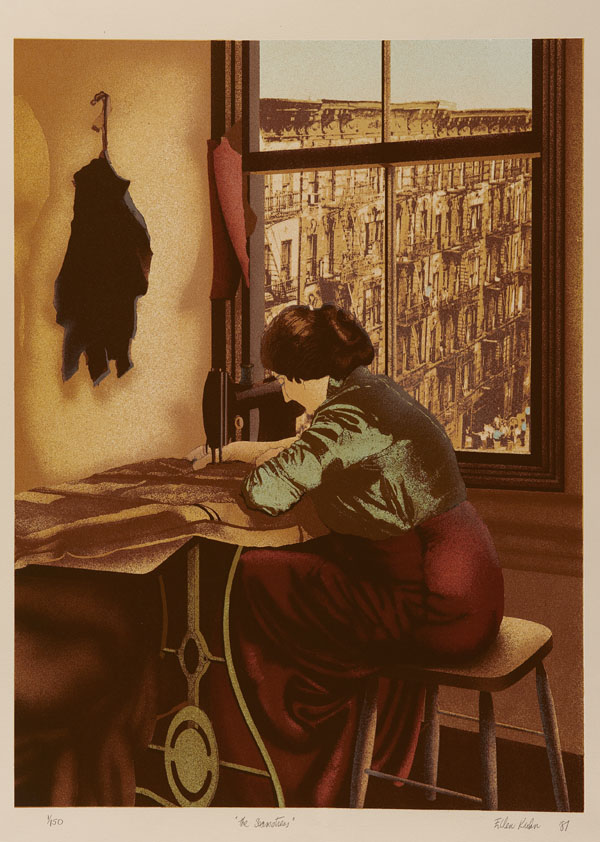
The Seamstress
Artist information
Other name Ellen Charap, Ellen Kuhn Charap
Born Munich, Germany
Died London, England
Find more work in the collection by this artist
Find out more about this artist
Ellen Kuhn was born into a Jewish family in Munich, Germany on 20 April 1937. In August 1939 she fled with her family to New York, catching the last Holland-American line ship. They settled in Harlem, and she attended her first life-drawing class aged eight. As a teenager she studied at the University of Wisconsin, completing a masters in fine art at Berkeley. After meeting and marrying scientist John Charap in San Francisco, the couple moved to England, settling in London. Her work ranged from commercial printing to abstract expressionism, deriving from her period in New York. During the 1960s, she also produced work that drew on civil unrest including the war in Vietnam.
In England, she painted London's busy streets and monuments, and at night became fascinated by the transition of the River Thames into a world of abstract colour and form. One of the most fruitful times in her creative life was at The Place Theatre, where in the 1980s, she attended rehearsals, drawing the dancers in action. She worked fast in coloured chalk and pencils, with free gestures and later made more ambitious works based on photographs she had taken in situ. She taught at the Henrietta Barnett School, the London College of Furniture and Camden Arts Institute. She first exhibited at Ben Uri in the Annual Summer Exhibition in 1964, and also had a joint exhibition at Ben Uri with Belinda Harding in 1983. She also taught at the Henrietta Barnett School, the London College of Furniture and Camden Arts Institute. She lived in Hampstead and after a long illness, she died there on 10 July 2013. Her work is also represented in the Victoria and Albert Museum.
Object Details
Date 1981
Object type print
Medium photolithograph on paper
Materials and techniques ink (medium) lithography (technique) paper (support)
Unframed 85.5 x 65 cm
Signed and dated (lower right): Ellen Kuhn '87
Acquisition Presented by Mr Laurie Lowenthal, 1997
Accession number 1997-5
Display status not on display
The Seamstress references the Schmatte (garment or rag trade) associated with successive waves of immigrants to the East End including Jewish tailors and seamstresses, before them the Huguenot weavers, and later the Bangladeshi garment industry. The artist did not reside in the East End but is known to have made work on social issues in the 1960s.
Keywords
architecture | East End | genre scene | interior | needlework | print | schmatte | woman
Hover mouse cursor over image to zoom (you can also use the mouse wheel).