Ben Uri Collection

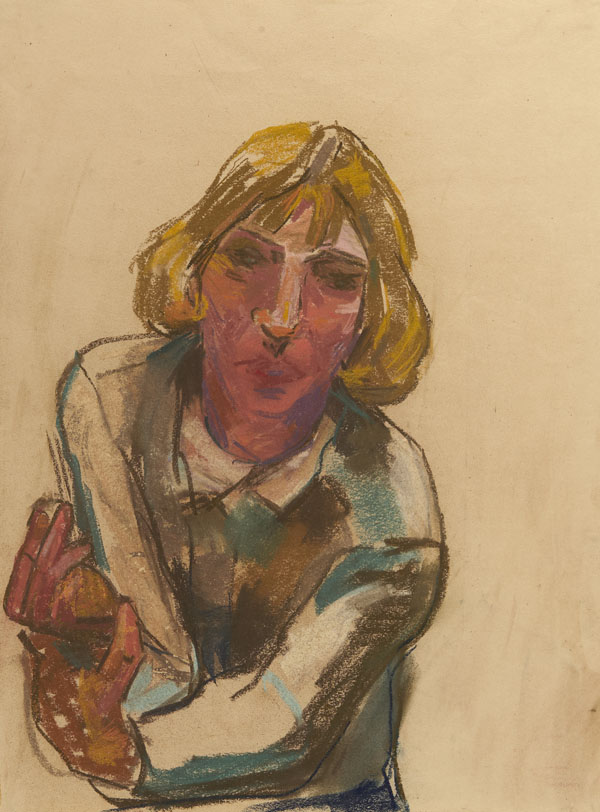
Frau Trautl Schranz
Artist information
Name Hilde Goldschmidt (1897-1980)
Born Leipzig, Germany
Died Kitzbuhel, Austria
Find more work in the collection by this artist
Find out more about this artist
Hilde Goldschmidt was born into a Jewish family in Leipzig, Germany on 7 September 1897 and trained in book design at the Academies of Fine Arts in both Leipzig and Dresden; at the latter she also joined Oskar Kokoschka's painting classes between 1920 and 1923. Upon his departure, the class was dissolved, and Goldschmidt left for New York, holding an exhibition at the New Gallery in the same year. Returning to Europe in 1926, she studied in Paris before travelling to the South of France, where she remained until 1929, then moved to Italy, where she settled in Capri. She later returned to Germany and held her first large exhibition in December 1932 at the Galerie Caspari, Munich.
In 1933, following Hitler's accession to the Chancellorship, Goldschmidt was forced to flee Germany and, inspired by the Tyrolean landscape, settled in Kitzbühel, Austria, exhibiting at the Galerie Wuerthle, Vienna in 1934. Unable to return to Germany ‘for political reasons’, she moved to England with her mother in the spring of 1939, earning her living by ‘handicrafts’, until following a meeting with Kokoschka in 1941 in Cornwall, she resumed painting. In 1942 she settled in the Lake District, where she was moved by 'the grandeur of the scenery', and began a friendship with the refugee artist and 'Merz' collagist Kurt Schwitters, part of the Langdale group which included the philosopher Olaf Stapledon and the dancer Rudolf von Laban. She remained there until 1949. In the autumn of that year her Lake District work was exhibited in Manchester. In 1950 she returned to Austria and settled finally in her house and studio in Kitzbühel, holding exhibitions in Munich and Basel, and receiving an honorary Professorship from the Austrian President. After 1954 she taught at Kokoschka's Summer School for Seeing in Salzburg. Her first solo London exhibition was with Ben Uri in 1959 and she also showed with émigrée gallerist Annely Juda in 1969, and at Abbot Hall Art Gallery (and tour) in 1973. She died in Kitzbühel, Austria on 7 August 1980. Her work is held in UK collections including Abbot Hall in the Lake District and Tate. Hilde Goldschmidt's niece, ceramicist Brigitte Goldschmidt (later known as Brigitte Appleby), later formed Briglin pottery with Eileen Lewenstein.
Object Details
Date 1951
Object type drawing
Medium pastel on paper
Materials and techniques pastel (medium) paper (support)
Unframed 50 x 37.4 cm
Framed 63 x 50.5 cm
Acquisition presented by Brian & Brigitte Appleby 1996
Accession number 1996-4iii
Display status not on display
This bold portrait of Frau Trautl Schranz was probably executed in Hilde Goldschmidt’s Kitzbühel studio in 1951, where she returned after spending the war years in England. The style, however, draws on her early training at Dresden Academy of Art in the 1920s under Austria’s most famous Expressionist painter, Oskar Kokoschka, whose composition and sense of colour strongly influenced her style. The work was presented to the Ben Uri Collection by the artist's niece, ceramicist Brigitte Appleby, who formed the Briglin Pottery partnership with fellow potter Eileen Lewenstein.
Keywords
drawing | expressionism | portrait | woman
Selected exhibition history
2017
Refugees: The Lives of Others - German Refugee Artists to the UK
Ben Uri Gallery and Museum
2018
Finchleystrasse: German artists in exile in Great Britain and beyond 1933-45
Embassy of the Federal Republic of Germany, London (Department of Culture and Education)
2019
Migrations: masterworks from the Ben Uri Collection
Gloucester Museum
2024
US: From There to Here - Britain's Gain
Ben Uri Gallery and Museum
Literature
'Finchleystrasse: German artists in exile in Great Britain and beyond 1933-45' (London: Ben Uri Gallery and Museum in association with the German Embassy London, 2018), p. 26.
Hover mouse cursor over image to zoom (you can also use the mouse wheel).