Ben Uri Collection

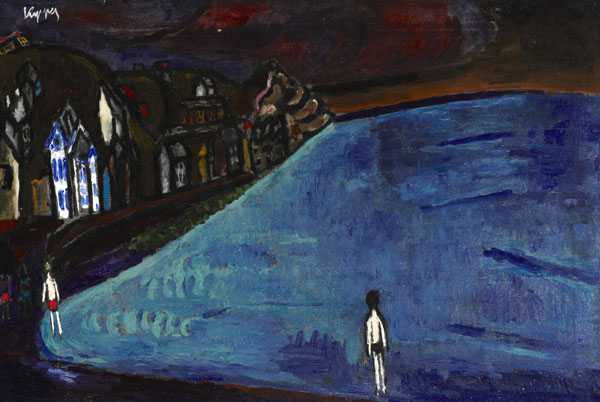
Sennen
Artist information
Born Berlin, Germany
Died Cwmerfyn, Wales
Find more work in the collection by this artist
Find out more about this artist
Heinz Koppel was born into a Jewish family in Berlin, Germany on 29 January 1919; his parents divorced in 1930 and his father, Joachim, remarried. Koppel showed an early interest in art and had private art lessons under the painter Grigorij Oscheroff while at Secondary school. Following the rise of Nazism, Joachim, who had established business interests in Prague, took his family there for safety in 1933 and Koppel took private lessons from the painter Friedrich (later Fred) Feigl. In 1935-36 he travelled to London and studied under Martin Bloch at his School for Contemporary Painting until, after losing their German citizenship, the family became 'stateless persons', living briefly in Italy and Antwerp, before gaining Costa Rican citizenship and returning to Britian in 1938. Joachim established his business in the Treforest Industrial Estate, near Pontrypridd, Wales in 1939, and in the same year, Koppel resumed lessons with Bloch in London. In 1941 he began teaching at the Burslem School of Art in Stoke-on-Trent and in 1942 exhibited at Jack Bilbo’s Modern Art Gallery in Baker Street, London.
In 1944 Koppel moved to Dowlais, South Wales, at the invitation of arts educator and philanthropist Mary Horsfall of Gwernllwyn House, who ran classes for the unemployed. He worked as an art teacher in Merthyr Tydfil Educational Settlement, a school for workers and their families, and established the Merthyr Tydfil Art Society the same year. In spring 1947 he exhibited in an exhibition called Some Pictures from a South Wales Town, an Arts Council of Great Britain touring exhibition, which brought together his work with his Merthyr students, curated by David Bell (Assistant Director for Art at the Wales office). In 1948 Koppel became head of the Dowlais Art Centre, leading to a Dowlais group exhibition at the National Museum of Wales in Cardiff. He also had a joint exhibition with sculptor John Brown at the Kingly Gallery, London in 1949 and exhibited at the Whitechapel Art Gallery.
In 1956 he returned to London, exhibiting at Helen Lessore's Beaux Art Gallery (1958, 1960, 1963) and participated in group shows at Ben Uri Gallery (1946, 1960). He taught at Hornsey School of Art (1960), and at Camberwell (1960-63), and became senior lecturer for Painting at Liverpool College of Art (1964), then a professor at the Slade School of Fine Art. He spent his final years in Aberystwyth; his last exhibition was at the Oriel Gallery, Cardiff in 1978. Heinz Koppel died in London, England on 1 December 1980. A retrospective was held at the Gillian Jason Gallery, London in 1988 and at the Berlin Centrum Judaicum in 2010. His work is in UK collections including the Arts Council Collection, Ben Uri Collection, Bodelwyddan Castle, Cyfarthfa Castle Museum & Art Gallery, Leicester Museums & Art Gallery, the National Museum of Wales in Cardiff, Newport Museum & Art Gallery, and Tate.
Object Details
Date 1960
Object type painting
Medium oil on canvas
Materials and techniques oil (medium) painting (technique) canvas (support)
Unframed 61 X 91 cm
Framed 63 x 92.5 cm
Signed (upper right): 'Koppel'
Acquisition presented by Frank Auerbach from the Estate of David Wilkie 1994
Accession number 1994-12
Display status not on display
Koppel depicts the tiny West Cornwall village of Sennen in a typically naïve, almost Surreal style, although his treatment and distinctive colouring also reflect a debt to German Expressionism. A psychological element is introduced by the dominant bend of the cove and its great blue stretch of water which threatens to swallow up the houses and overwhelm the two small boys.
Selected exhibition history
1961
Opening Exhibition
Ben Uri Art Gallery
2009
Homeless & Hidden 2: World Class Collection Homeless & Hidden
Ben Uri Gallery
2009
Heinz Koppel: Ein Künstler zwischen Berlin und Wales
Centrum Judaicum
2018
Finchleystrasse: German artists in exile in Great Britain and beyond 1933-45
Embassy of the Federal Republic of Germany, London (Department of Culture and Education)
2019
Art-exit: 1939 - A Very Different Europe
12 Star Gallery
2023
Josef Herman: Artistiaid Ffoadur Cymru - Refugee Artists
Hay Castle
Literature
'Finchleystrasse: German artists in exile in Great Britain and beyond 1933-45' (London: Ben Uri Gallery and Museum in association with the German Embassy London, 2018), p. 30.; Oil Paintings in Public Ownership in Camden (London: The Public Catalogue Foundation, 2013), p.23 (illus. included); Chana Schütz and Anna Canby Monk, eds., Heinz Koppel: Ein Künstler zwischen Berlin und Wales (Berlin: Centrum Judaicum, 2010); Walter Schwab and Julia Weiner, eds., Jewish Artists: the Ben Uri Collection - Paintings, Drawings, Prints and Sculpture (London: Ben Uri Art Society in association with Lund Humphries Publishers Ltd, 1994), p. 132.
Hover mouse cursor over image to zoom (you can also use the mouse wheel).