Ben Uri Collection

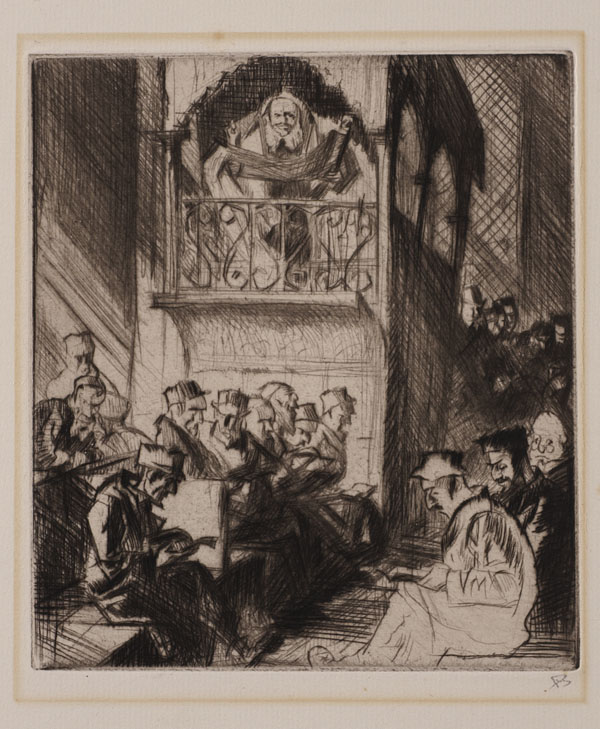
Sermon in the Synagogue
Artist information
Name Frank Brangwyn (1867-1956)
Born Bruges, Belgium
Died Ditchling, England
Find more work in the collection by this artist
Find out more about this artist
Artist (Guillaume François) Frank Brangwyn was born on 13 May 1867 into an Anglo-Welsh Roman Catholic family in Bruges, Belgium, where his father had undertaken an ecclesiastical architectural commission. Following its completion, the family returned to England in 1875. Brangwyn received no formal art education but was encouraged to sketch at the South Kensington Museum (now the Victoria & Albert Museum), where Arthur Heygate Mackmurdo, helped him secure an apprenticeship at William Morris’ workshop. At the age of 17, Brangwyn had his one of his earliest paintings accepted by the Royal Academy, and later gained a medal at the Paris Salon of 1891. In addition to painting and drawing, he also designed buildings, stained-glass panels, furniture, and interiors, and executed lithographs and woodcuts. Between 1902 and 1920 he also created large-scale murals for buildings in Britain, Europe, and North America including at the Royal Exchange (1906) and the Worshipful Company of Skinners in London, and Christ’s Hospital School Chapel, Sussex. In 1926 he began a commissioned series of large panels on the theme of the British empire for the House of Lords, which were controversially rejected in 1930, and subsequently installed four years later in the Guildhall in Swansea.
During the First World War Brangwyn was an official war artist and produced over 80 propaganda posters for use by organisations including the Red Cross. He was made an associate of the Royal Academy in 1904, and a Royal Academician in 1919, also becoming the first President of the Society of Graphic Art in the same year, and President of the Royal Birmingham Society of Artists (1925-26). In 1932 he received the Royal Society of Artists’ Albert Medal. In 1918 Brangwyn purchased a house in Ditchling, Sussex, where he spent his later years. In 1952 he became the first living artist to be given a retrospective at the Royal Academy. He died in Ditchling, Sussex on 11 June 1956. A Brangwyn museum was founded in 1936 in Bruges and a major exhibition was held in Leeds, Bruges, and Swansea in 2006 to mark the 50th anniversary of his death.
Object Details
Date 1931
Object type print
Medium drypoint on paper
Materials and techniques ink (medium) drypoint (technique) paper (support)
Unframed 17.2 x 15.2 cm
Signed (lower right) 'B'
Acquisition presented by Mr. H. J. Stern 1993
Accession number 1993-22
Display status not on display
Frank Brangwyn's Sermon in the Synagogue is a compelling etching depicting a rabbi delivering a sermon to an attentive congregation within a synagogue setting. Created in 1931, this artwork is part of a series of 63 etched illustrations for Jérôme and Jean Tharaud's book "L'Ombre de la Croix," which delves into the lives of Jewish communities in Europe.
Literature
Walter Schwab and Julia Weiner, eds., Jewish Artists: the Ben Uri Collection - Paintings, Drawings, Prints and Sculpture (London: Ben Uri Art Society in association with Lund Humphries Publishers Ltd, 1994), p. 118.
Hover mouse cursor over image to zoom (you can also use the mouse wheel).