Ben Uri Collection

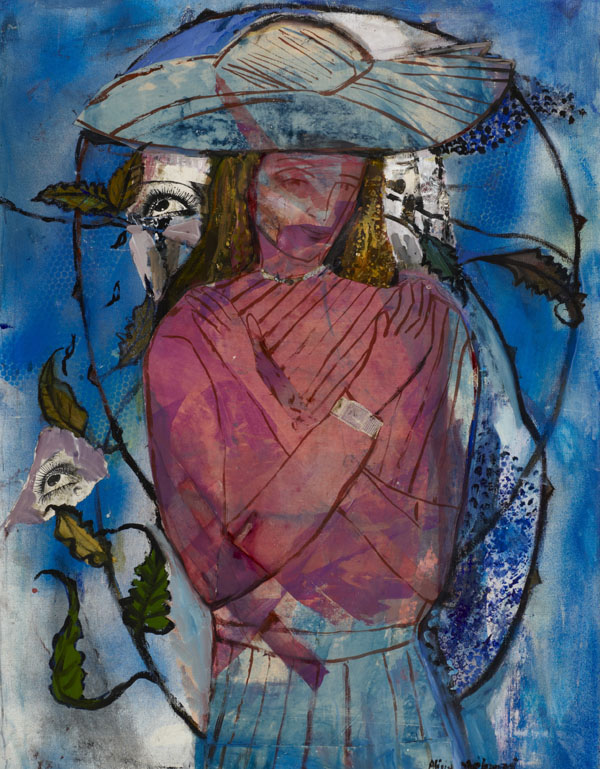
Tears
Artist information
Name Alicia Melamed Adams (1927-2022)
Other name Alicia Goldschlag
Born Boryslav, Poland (now Ukraine)
Died London, England
Find more work in the collection by this artist
Find out more about this artist
Painter Alicia Melamed Adams (née Goldschlag) was born into a Jewish family in Boryslav, in eastern Poland (now Ukraine) in 1927. As a teenager she studied drawing with the Polish-Jewish writer, artist and art teacher Bruno Schulz (later shot by a Nazi officer in 1942). After the German invasion of Poland in September 1939, she was the only member of her family to survive after the Jewish population of Drohobycz was forced into a ghetto. In 1946 she met and married fellow survivor Izrael Natan Melamed (later Adam Adams), a survivor of the Lublin, Majdan Tatarski and Warsaw ghettos, who had also lost his entire family. They were married in Warsaw in 1946. After two years in Paris, the couple moved to England, settling in London, where her aunt and family had fled before the war.
In the late 1950s Alicia attended art evening classes, which led her to St Martin’s School of Art, and then Sir John Cass College, where she was taught by tutors including Roland Vivian Pitchforth and Maggie Hambling. In 1963 she painted a series of works recalling her earlier life and the loss of family and childhood friends. These remained hidden in her studio for 20 years before she felt able to exhibit them in a fundraising exhibition for Amnesty International, afterwards exhibiting the entire series at the Ark T Centre in Cowley, Oxford, sponsored by the Bishop of Oxford, Rt Revd Richard Harries. She also produced pottery and etchings. In 1965 Melamed Adams became a member of the United Society of Artists with whom she regularly exhibited and and was a member of the Ridley Art Group. She showed in group exhibitions in London, including at Foyles Art Gallery (1984), also across the UK, and twice in Paris, continuing to paint until her eyesight failed. She had a solo exhibition at the London Jewish Cultural Centre in 2014. Her work was regularly exhibited at Ben Uri Gallery (entering the collection in 1993) including in Art Out of the Bloodlands: A Century of Polish Artists in Britain in 2017 and in Outlook: No Return. Polish Artists who fled Nazi-dominated Europe to British Culture, at POSK Gallery, London (2019), where she was interviewed by Simon Glass for a BBC London film marking Holocaust Memorial Day.
Alicia Melamed Adams died on 22 October 2022 in London, England. Her work is represented in UK public collections including the Imperial War Museum and the Ben Uri Collection; both institutions hold her oral testimony.
Object Details
Date 1993
Object type mixed media
Medium mixed media on canvas
Materials and techniques canvas (support)
Unframed 80 x 63 cm
Framed 93 x 74 cm
Signed (lower right): 'Alicia Melamid'
Acquisition presented by the artist 1993
Accession number 1993-20
Display status not on display
In 1963 Melamed-Adams produced a series of works commemorating her family’s fate. Tears, a later work, reflects both a personal and collective grief at the Holocaust.
Selected exhibition history
2017
Art Out of the Bloodlands: A Century of Polish Artists in Britain
Ben Uri Gallery
2018
Exodus: masterworks from the Ben Uri Collection
Bushey Museum
2018
Liberators: Extraordinary women artists from the Ben Uri Collection
Ben Uri Gallery
2019
Outlook: No Return. Polish artists who fled Nazi-dominated Europe to British culture
POSK: Polish Social and Cultural Association’s Gallery
Literature
Rachel Dickson, ed., From Adler to Zuławski: A Century of Polish Artists in Britain (London: Ben Uri Research Unit, 2020), p. 66 (illus. included); Oil Paintings in Public Ownership in Camden (London: The Public Catalogue Foundation, 2013), p.5 (illus. included); Walter Schwab and Julia Weiner, eds., Jewish Artists: the Ben Uri Collection - Paintings, Drawings, Prints and Sculpture (London: Ben Uri Art Society in association with Lund Humphries Publishers Ltd, 1994), p. 139.
Hover mouse cursor over image to zoom (you can also use the mouse wheel).