Ben Uri Collection

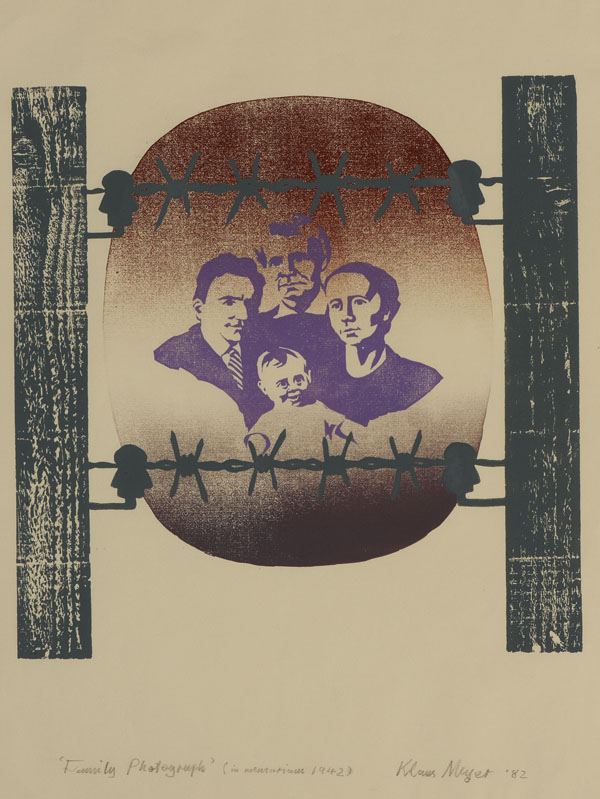
Family Photograph (In Memorium 1942)
Artist information
Born Berlin, Germany
Died Cambridgeshire, England
Find more work in the collection by this artist
Find out more about this artist
Klaus Meyer was born into an assimilated Jewish family in Berlin, Germany on 16 September 1918; his mother was a painter. Following Hitler's accession to the German Chancellorship and the introduction of anti-Semitic legislation, his father, a doctor, was banned from practising medicine in 1935 and died soon afterwards in 1937 (his mother later perished in Auschwitz, along with other members of the wider family).
In 1938, as the situation worsened, Meyer fled Berlin almost penniless. He joined his elder brother, composer Ernst Meyer, and his sister in London; he studied graphics at the Central School of Arts and Crafts and also took drawing classes. Upon the outbreak of the Second World War, Meyer was rejected for army service and as a so-called 'enemy alien' was interned, first in Shropshire and then in Onchan Camp, on the Isle of Man from 1940-42. Onchan had an active artistic community and Meyer participated in exhibitions and also submitted drawings to the camp newsletter, The Onchan Pioneer, with materials scarce, he sometimes used wallpaper as a support. After his release, he worked as a commercial artist on propaganda posters and married Celia Petszaft, a fellow refugee from Poland.
Meyer was a founder member of the Hampstead Artist’s Council and went on to study painting and printmaking at the Slade School of Fine Art. He then taught at the Hornsey College of Art and Kilburn Polytechnic in the 1960s and 1970s and held many solo and group exhibitions. Meyer often found inspiration for his art on nearby Hampstead Heath, as well as in literature and poetry, particularly by Goethe and other German writers. His bold style and use of experimental materials continued well into his later years. Klaus Meyer died in Cambridge, England on 7 June 2002.
Object Details
Date 1982
Object type print
Medium woodcut and linocut on paper
Materials and techniques ink (medium) linocut | woodcut (technique) paper (support)
Unframed 49 x 37.3 cm
Framed 68 x 54.1 cm
Signed and dated (lower right): 'Klaus Meyer '82'
Acquisition presented by the artist 1989
Accession number 1989-10
Display status not on display
This poignant print was created by the German-born Jewish artist Klaus Meyer in 1982, forty years after most of his family, including his mother, brother Ulrich and his wife Annemarie, perished in Auschwitz. Upon fleeing to Britain, Meyer himself was interned at the Onchan Camp on the Isle of Man (1940-1942). The heads and shoulders of two women, a man and a young child are depicted in an oval reminiscent of an old-fashioned photograph. The family is visually confined behind two rows of barbed wire, stretched between two wooden posts. The wire creates a barrier between them and the viewer, evoking a sense of imprisonment and distance. Meyer’s work is an interesting example of two different printing techniques employed in one print: while the ‘photographic’ element is a linocut, the barbed wire and fence are a woodcut, the latter chillingly evoking the physical texture of a camp’s wooden fence.
Selected exhibition history
1989
Prints and Drawings from the Permanent Collection
Ben Uri Art Gallery
1992
Jewish Artists at the Slade: Auerbach, Bomberg, Cohen, Gertler (and recent acquisitions)
Ben Uri Gallery
2009
Homeless & Hidden 2: World Class Collection Homeless & Hidden
Ben Uri Gallery
2016
Art and the Holocaust
Ben Uri Gallery
Literature
Walter Schwab and Julia Weiner, eds., Jewish Artists: the Ben Uri Collection - Paintings, Drawings, Prints and Sculpture (London: Ben Uri Art Society in association with Lund Humphries Publishers Ltd, 1994), p. 140.
Hover mouse cursor over image to zoom (you can also use the mouse wheel).