Ben Uri Collection

Portrait of Theodore Herzl
Artist information
Name Leopold Pilichowski (1866-1933)
Other name Lajb Pilichowski, Levek Pilichowski
Born Pila, Poland
Died London, England
Find more work in the collection by this artist
Find out more about this artist
Leopold Pilichowski was born into a Jewish family of farmers in Pila, near Sieradz, Poland on 23 March 1869. He was taught to draw by the painter Samuel Hirszenberg (to whom he was distantly related), and studied at the Art Academy in Munich and later at the Academy Julian in Paris, holding his first exhibition in Łódź in 1894. Around 1895 he began to address Jewish themes in his work, particularly the poverty of Jews in the cities. This commitment to social commentary led him to depict Jewish immigrants, wanderers and pedlars. He exhibited in Paris from 1899 onwards, studying with Benjamin Constant and moving to the city with his wife, Lena Pillico, around 1904 (he later received the Legion of Honour from the French government in 1927), exhibiting there, as well as in London, New York and Warsaw. In 1906 his work was included in the exhibition of Jewish Art and Antiquities at the Whitechapel Art Gallery in London, as well as in an exhibition of works by Jewish artists in Cracow and in 1907 he helped to co-organise an exhibition of Jewish Artists at the Gallery for Ancient and Modern Art in Berlin including his own work on the subject of exile. From 1908 Pilichowski was an active Zionist and probably his most famous portrait is one of the Zionist leader Theodor Herzl, painted in the same year and which is believed to exist in two versions (one in the Central Zionist Archives, Jerusalem; another in the Ben Uri collection).
A decade later, in 1913, at the age of 45, he moved to London, with his wife (the artist Lena Pillico) and their children, aided by Hebrew writer David Frishman. He travelled frequently between Paris and Łódź in 1914 and upon his return to London, concentrated on painting the impoverished Jews of Whitechapel. He lectured at the Ben Uri Art Society in 1916, and, again, in 1921, becoming Hon. President in 1926 – a position he held until 1933. In 1925 he depicted Lord Balfour delivering his speech among a crowd at the inauguration of the Hebrew University at Mount Scopus, Jerusalem and in 1927, reflecting on his visit, he lectured at Ben Uri on 'Palestine As Seen By An Artist', describing the close connection of the Jewish soul and spirit to the holy city of Jerusalem. He also served as president of the Association of Polish Jews in London. An 'Exhibition of portraits, landscapes, Jewish life studies, &c. by Leopold Pilichowski' was held at the Goupil Gallery, London in 1924 and he also participated (as did his wife, Lena Pillico) in the important survey exhibition 'Jewish Art and Antiquities' at the Whitechapel Art Gallery in 1927. In 1928 husband and wife were both also among the 16 artists who exhibited work at the Brooklyn Museum exhibition of 'Paintings, Sculpture and Drawings by American and European Artists' with Pilichowski showing 17 paintings (including a portrait of British Conservative politician Lord Balfour, architect of the 'Balfour declaration') to 29 by Pillico. In 'The Catalogue and Survey of Activities', published by the Jewish Art and Literary Society Ben-Uri in 1930, it was recorded that 'Mr. Pilichowski is one of the most popular Jewish painters of the older generation, and is at the present time, the President of the Ben Uri. Mr. Pilichowski, as already alluded to, has been of great assistance to the Society by reason of his expert advice and lectures on Jewish art which always attract large and eager audiences'. The minutes for 1931 refer to his donation of 30 pictures, at a nominal charge, including those by Josef Israels, Leopold Gottlib, Hermann Struck and Leon Hirszenberg.
Leopold Pilichowski died in London, England on 29 July 1933 and is buried in Willesden United Synagogue cemetery. Much of his oeuvre was destroyed by bombing during the Second World War. Surviving examples of his work are held in the Ben Uri Collection in the UK and in collections abroad including the Louvre, Paris; National Museums of Crakow and Warsaw; the City Museum of Łódź; and the Jewish Museum, New York.
Object Details
Date 1907
Object type painting
Medium oil on canvas
Materials and techniques oil (medium) canvas (support)
Unframed 91 x 55.5 cm
Framed 108.7 x 73 cm
Signed (lower right): 'L. Pilichowski'
Acquisition on loan from Charles Rotenberg 1988
Accession number 1988-47
Display status not on display
This portrait, made in 1907, three years after the subject's death, shows the Zionist leader Theodor Herzl (1860-1904) dressed as a European intellectual, but his posture and surroundings are reminiscent of biblical depictions of Moses. In this way the artist associates a thoroughly modern personality with tradition and vision underlining his qualities as a leader. Theodor(e) Herzl became famous for his publication ‘Der Judenstaat’ (‘The Jewish State’) in 1895. He was not the first to suggest that Jews form their own state, however it was his idea of a return to Palestine that eventually led to the foundation of Israel.
Pilichowski is best known for his depictions of Jewish life, religious representations and many scenes of Jewish suffering, but he also painted landscape and portraiture. In his time, some people criticised the artist for the sobriety, with which he had depicted the political leader, although from 1908 Pilichowski was himself an active Zionist.
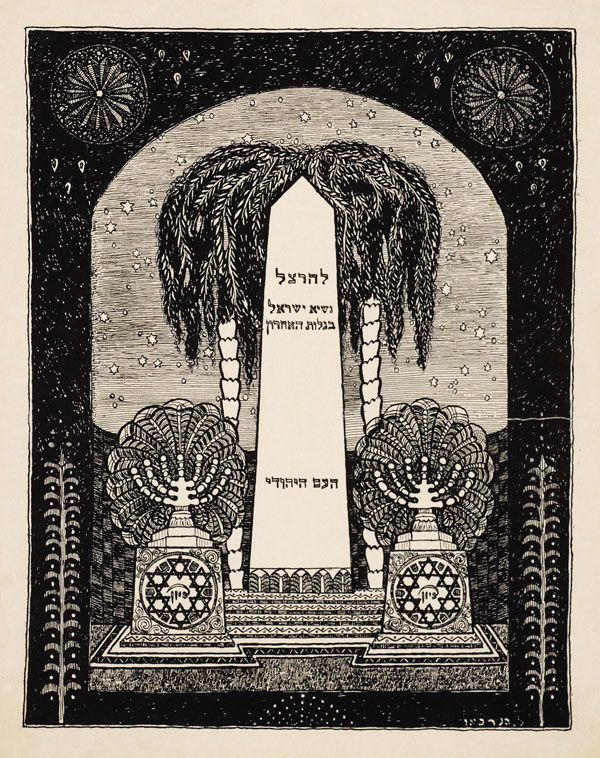
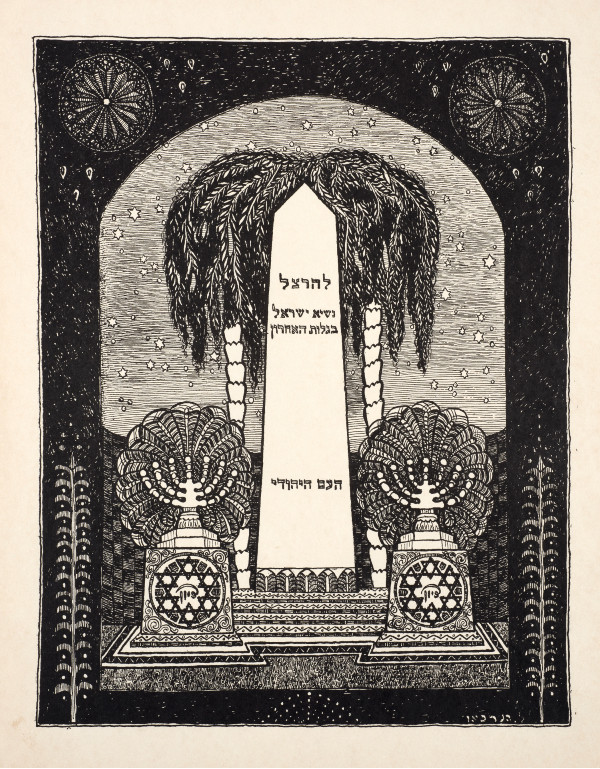
The Ben Uri Album (1916) with illustrations by founder Lazar Berson includes a plate depicting a monument to Herzl.
Selected exhibition history
2009
Homeless & Hidden 1: World Class Collection Homeless & Hidden
Ben Uri Gallery
2015
Moïse Figures d’un prophète
Musée d’art et d’histoire du Judaïsme
2016
100 for 100: Ben Uri Past, Present & Future
Christie's South Kensington
Literature
Oil Paintings in Public Ownership in Camden (London: The Public Catalogue Foundation, 2013), p. 32 (illus. included); Walter Schwab and Julia Weiner, eds., Jewish Artists: the Ben Uri Collection - Paintings, Drawings, Prints and Sculpture (London: Ben Uri Art Society in association with Lund Humphries Publishers Ltd, 1994), p. 144.

Hover mouse cursor over image to zoom (you can also use the mouse wheel).
To license this image contact Bridgeman images
Related works