Ben Uri Pre-Eminent Collection

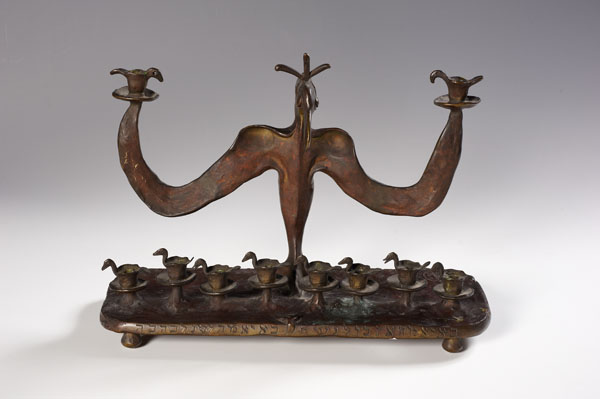
Chanukiah with Doves
Artist information
Other name Edward Goodack, Edward Good, Moshe Oved, Moysheh Oyved
Born Skepe, Poland
Died London, England
Find more work in the collection by this artist
Find out more about this artist
Writer, sculptor, jeweller, founder of the antique jewellery shop Cameo Corner, and dealer in cameos and antique jewellery, Mosheh Oved (aka Edward Goodack or Edward Good) was born into a Jewish family in Skepe, then within the Russian Empire (now Poland) in 1885. In 1903 he immigrated to England and settled in London’s East End, where he initially worked as a watchmaker. After establishing Cameo Corner, located first at 1 New Oxford Street, and after the Second World War in Museum Street, he also designed and made his own jewellery and metalwork. In the 1920s Oved met his future wife, jewellery designer Gwendoline Ethel Rendell (1900–1983); largely self-taught, she had worked for the Arts and Crafts jeweller John Paul Cooper, and by 1924 had her own workshop in Doughty Street under the name of Miss Rendle. She converted to Judaism and took the name Sah Oved, producing radical jewellery in the interwar and postwar years.
Oved was a founding member of the Ben Uri Society in 1915 and made a gold and diamond brooch to Lazar Berson’s design for Ben Uri in 1916. He was a great supporter of Yiddish culture, holding an honorary office within Ben Uri from its inception until 1956, and always maintaining that its main goal should be to collect pictures and open a gallery. The collection in these years was influenced by his taste as he helped to fund and facilitate the acquisition of a number of important early works by artists including Simeon Solomon, Jacob Kramer, David Bomberg and Samuel Hirszenberg. In 1924 his portrait was painted by fellow Polish artist Maurice Minkowski and Oved presented it to the Ben Uri Collection in 1929.
Oved collected 124 autobiographical stories and short tales in his book Visions and Jewels (1925), and included anecdotes about Max Nordau, Sholem Asch and Jacob Epstein, among many others. His other volume, The Book of Affinity (1933) was a deluxe production with original colour lithographs by Epstein (Oved presented two busts by Epstein to Ben Uri in 1947).
From 1927 to 1937 the Oveds lived in Jerusalem, afterwards returning to London. According to anecdote, it was while sheltering in the basement of Cameo Corner during the Blitz, that Oved first began casting in wax animal rings designed by Sah to steady his trembling hands. He took up sculpting at the end of the war. In 1948 an exhibition, Sculptural Expressions by Mosheh Oved, comprising 16 bronze heads, 15 'Beasts and Birds', 7 candelabra, described as 'in commemoration of the 6,000,000 exterminated Jews', and a piece described as 'Chessman', executed between 1946 and 1948, was held at St George's Gallery, 81 Grosvenor Street, London, then under the directorship of Viennese émigré Lea Bondi Jaray. A foreword describes how 'At the age of 60 Mosheh Oved long known as a writer has found a new way of expressing his fantasies and visions through the medium of sculpture. This exhibition is the product of the last two years work'.
Mosheh Oved died in London, England in 1958. His work is represented in the UK in the Ben Uri Collection. Examples of Sah Oved’s jewellery are held in the V&A.
Object Details
Object type sculpture
Medium bronze
Materials and techniques sculpture (technique) bronze (support)
Dimensions 27 x 38 x 16 cm
Acquisition presented in honour of the Mamlok family 1988
Accession number 1988-36a
Display status not on display
According to anecdote, it was while sheltering in the basement of his jewellery shop, Cameo Corner, during the Blitz of 1940-41, that Moshe Oved first began modelling animal design rings to steady his trembling hands. He took up sculpting at the end of the war in his sixties and created a series of small bronze heads and a number of candelabra to commemorate the victims of the Holocaust. Chanukiah with Doves is one of 11 works by Oved in the Ben Uri Collection, which also includes a group of heads, designs for commemorative rings and a highly individual menorah.
Chanukkah commemorates the rededication of the Holy Temple and the victory of the Maccabees (Jewish army) over the Seleucids (Syrian-Greeks) circa 167 BCE. It lasts eight days, to commemorate the miracle that happened when the Maccabees had only enough oil to burn in their lamp for one night, but instead, it burned for eight nights. The chanukiah or hanukkiah is a type of menorah (lamp) in the form of a candelabra specifically designed to hold the Hanukkah candles and traditionally contains room for nine candles - one for each night of the eight-night holiday - plus the shammash or helper candle, which is used to light the others, although there are some extant examples of antique European ten candle-holders. Oved's delightful hanukkiah, centred around the form of a dove, similarly contains room for ten candles: eight in the form of tiny individual doves on the base of the piece and two at the end of the branching wings of a standing dove. The lighting of the candles is the main ritual of Hanukkah with one candle added each night until, on the eighth and final evening, the hanukkiah is ablaze with light. Doves are traditionally symbols of peace and light. In the Old Testament story of Noah's Ark, the dove carrying an olive branch brings peace and light to the world after the flood, and the eight days of oil in the story of Chanukkah also brought light to the Maccabees.
Selected exhibition history
2006
Jewish Artists in Britain Celebrating the 350
Arts Depot
2009
Homeless & Hidden 2: World Class Collection Homeless & Hidden
Ben Uri Gallery
2015
Out of Chaos – Ben Uri: 100 Years in London
Somerset House
Literature
Rachel Dickson and Sarah MacDougall, eds., 'Out of Chaos: Ben Uri; 100 Years in London' (London: Ben Uri Gallery, 2015) pp. 104-105.; Walter Schwab and Julia Weiner, eds., Jewish Artists: the Ben Uri Collection - Paintings, Drawings, Prints and Sculpture (London: Ben Uri Art Society in association with Lund Humphries Publishers Ltd, 1994), p. 142.
Hover mouse cursor over image to zoom (you can also use the mouse wheel).