Ben Uri Collection

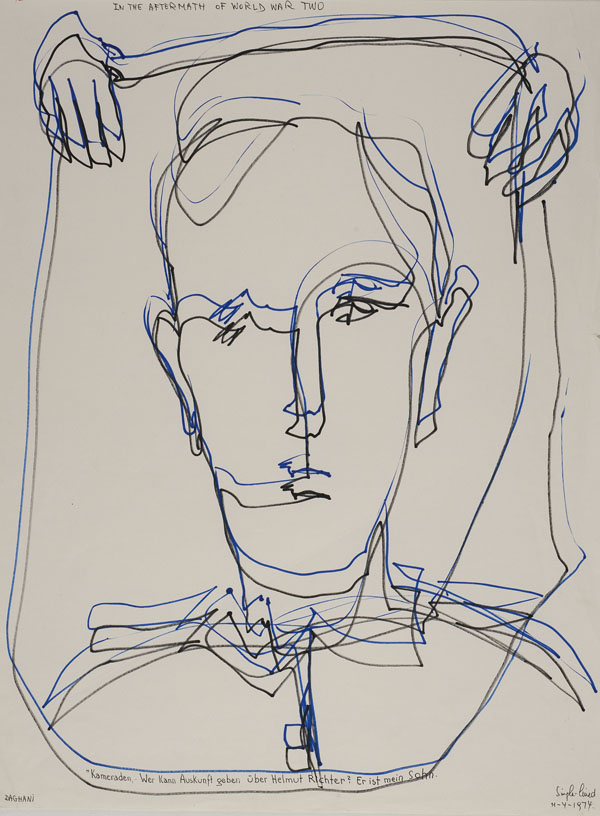
In the Aftermath of World War Two (I)
Artist information
Name Arnold Daghani (1909-1985)
Other name Arnold Korn
Born Suceava, Romania
Died Hove, England
Find more work in the collection by this artist
Find out more about this artist
Artist Arnold Daghani (né Arnold Korn) was born into a Jewish family in Suczawa, Romania on 22 February 1909 and studied fine art informally in Munich and Paris during the 1920s. A gifted linguist, he then moved to Bucharest, found work as an export clerk, and changed his surname from Korn to Daghani. Following the outbreak of the Second World, then an earthquake in 1940, Daghani and his wife, Anisoara, moved to Czernowitz, from where, in 1942 they were deported to the Czernowitz Ghetto, then transferred to Mykhailivka concentration camp in the Ukraine, where Daghani made haunting sketches of his fellow prisoners. In June 1943 the couple were transported to Gaisin, under orders to create a mural for the August Dohrmann Company’s headquarters; from here they escaped to Bucharest, and in December 1943 they were liberated from the Bershad Ghetto. After the war, at odds with the ruling regime, the couple left Romania in 1958. They spent two years in Israel before travelling to Italy, Switzerland, and the south of France, then finally settled in England in 1977.
Daghani was a prolific artist and documented his fragmented life of upheaval and change through both his artworks and writings, despite suffering from chronic depression and occasional suicidal tendencies. His oeuvre encompassed many genres from images of everyday life to still-life drawings, collages, and lithographs, as well as paintings, many with a particular focus on the Holocaust. His first exhibition, A Relentless Spirit in Art 1944–1984, was held at Brighton Polytechnic in 1984. Arnold Daghani died in Hove, Sussex on 6 April 1985.
In 1987 Monica Bohm-Duchen's monograph on Daghani was published and in 1992 she opened the posthumous exhibition, 'Drawings by Arnold Daghani', at Ben Uri Gallery in Dean Street, Soho, to coincide with the publication, 'The Seven Days of Schlemihl', authored and illustrated by Daghani; a retrospective at the Barbican Centre; and a selling exhibition at John Bonham/Murray Feely Fine Art, were also held the same year. Daghani's work is held in UK Collections including the Imperial War Museum, Warwick University, and the University of Sussex - the latter holding a collection of some 6,000 Daghani works.
Object Details
Object type drawing
Medium pen and ink and blue marker on paper
Materials and techniques ink | pen (medium) paper (support)
Unframed 58 x 45 cm
Signed (lower right): Daghani
Acquisition presented by Carola Grindea 1986
Accession number 1988-14ix
Display status not on display
Number 9 in a portfolio of 47 loose works.
Keywords
drawing | man | portrait | World War II
Literature
Walter Schwabe and Julia Weiner, eds., Jewish Artists: the Ben Uri Collection - Paintings, Drawings, Prints and Sculpture (London: Ben Uri Art Society in association with Lund Humphries Publishers Ltd, 1994), p. 119.
Hover mouse cursor over image to zoom (you can also use the mouse wheel).