Ben Uri Collection

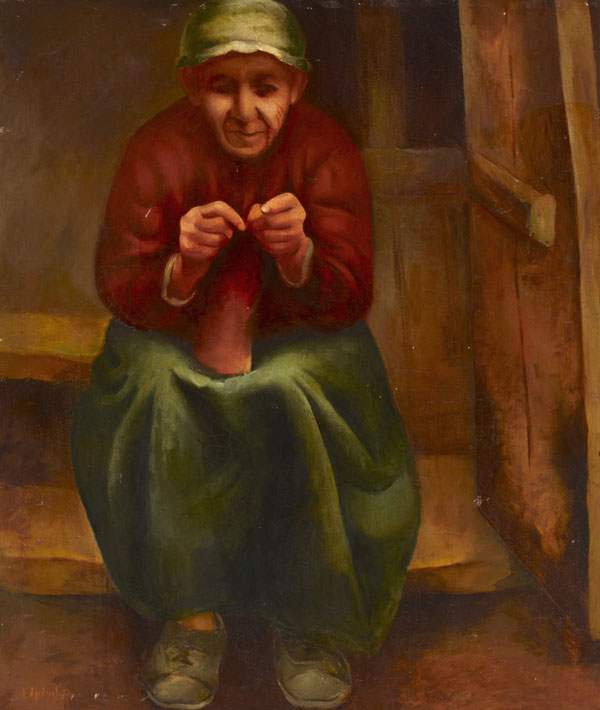
Woman Knitting
Artist information
Name Nathan Spiegel (1886-1942)
Other name Nathan Spigel, Natan Spigel, Natan Szpigel, N Szpigel, Natan Szpigiel
Born Łódź, Poland
Died Treblinka, Poland
Find more work in the collection by this artist
Find out more about this artist
Natan Szpigel (also known as Nathan Spiegel and Spigel) was born into an Orthodox Jewish family in Łódź, now in Poland, in 1886, where he studied art before travelling to Rome on a scholarship in 1920 to continue his studies under Henryk (Enrico) Glicenstein. Spiegel was a key member of the Expressionist group Jung Jidysz (Young Yiddish), a Łódź-based group of painters and writers dedicated to the expression of their Jewish identity, which also included Jankel Adler. He was also a member of ‘Start’, a group of mainly Jewish, Łódź-based artists, who exhibited across Poland throughout the 1920s and 1930s. He first exhibited in Łódź in 1921, before moving to Dresden, where he lived from 1923–25, and finally, Paris, where he settled in Montparnasse. He was influenced by Impressionism and painted landscapes, portraits and still lifes, as well as religious subjects. He gained attention following an invitation to show in the 1924 Salon d'Automne.
Szpigel was invited to exhibit at the Ben Uri Gallery in London in 1930 and introduced to its members at the Annual Conference of the Ben Uri on 6 February 1931, resulting in the Exhibition of Paintings in Oil and Watercolours by Nathan Spiegel (52 works) at 63 Mansell Street, Aldgate, E1 (10–24 March 1931). The catalogue introduction by Waldemar George described Spiegel as a 'visionary painter', portraying realistic subject matter in a dramatic style. His work was also included in group shows at Ben Uri (as 'M. Szpigel') in the 1934 Exhibition of Paintings and Sculpture by Jewish Artists; (as 'N. Szpigel') in the 1935 Annual Exhibition of Works by Jewish Artists and (again as N. Szpigel) in the Exhibition of Paintings by A. A. Wolmark (Konstam Collection) Dobrinsky – Paris and Selected Works from the Ben Uri Art Collection at Portman Street in 1945. He also exhibited regularly in group shows in Łódź (1921), Cracow (1928) and Warsaw (1937).
By the 1930s, Spiegel's work was in collections in Poland, London, and Jerusalem. Shortly after the German invasion of Poland in 1939, Spiegel, together with his family, was interned. Accounts differ as to whether he was held in the Łódź or Radomsko ghetto, where he continued to paint. He is believed to have perished in the Treblinka extermination camp in 1942. Today Spiegel's work can be seen in public collections in Tel Aviv, London, Lublin, and Ein Harod. Only about 20 of his paintings are definitely known to have survived.
Object Details
Object type painting
Medium oil on canvas
Materials and techniques oil (medium) canvas (support)
Unframed 92.2 x 77.3 cm
Framed 107.2 x 93 cm
Signed (lower left): Szpigel
Acquisition presented by Jack Green
Accession number 1987-409
Display status not on display
Keywords
genre scene | knitting | painting | perished | Radomsko ghetto | Treblinka | woman
Selected exhibition history
1931
Exhibition of Paintings in Oil and Watercolours by Nathan Spiegel at Ben Uri Gallery
Ben Uri Jewish Art & Literary Society
1935
Israel Zangwill Memorial Exhibition
Ben Uri Jewish Art Gallery
Literature
Oil Paintings in Public Ownership in Camden (London: The Public Catalogue Foundation, 2013) p. 41; Walter Schwab and Julia Weiner, eds., Jewish Artists: the Ben Uri Collection - Paintings, Drawings, Prints and Sculpture (London: Ben Uri Art Society in association with Lund Humphries Publishers Ltd, 1994), p. 102.
Hover mouse cursor over image to zoom (you can also use the mouse wheel).
Related works

Self-Portrait
by Enrico Glicenstein
Ein Jude
by Jankel Adler