Ben Uri Collection

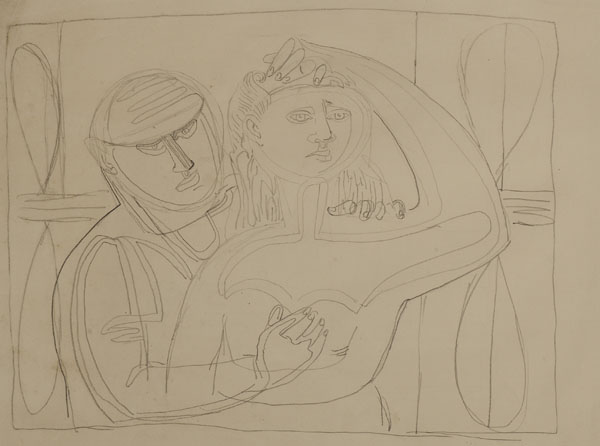
Interior with Female Figure
Artist information
Other name Yankel Adler, Jankiel Adler, Jakub Adler
Born Tuszyn, nr. Łódź, Poland
Died Aldbourne, England
Find more work in the collection by this artist
Find out more about this artist
Jankel Adler was born into a large orthodox Jewish family on 26 July 1895 in Tuszyn, near Łódź in the Congress Kingdom of Poland (now Poland). He studied engraving in Belgrade in 1912, then art in Barmen and Düsseldorf until 1914. Adler returned to Poland in 1918, becoming a founder-member of Young Yiddish, a Łódź-based group of painters and writers dedicated to the expression of their Jewish identity. During the First World War, he was conscripted into the Russian army, but resettled in Germany in 1920, notably meeting Marc Chagall in Berlin, before returning to Barmen. In 1922 Adler moved to Düsseldorf, joined the Young Rhineland circle, became friends with Otto Dix and helped found 'Die Kommune' and the International Exhibition of revolutionary artists in Berlin. His Planetarium frescos in 1925 were highly successful and he exhibited widely. In 1931, at the Düsseldorf Academy, he formed an important friendship with Paul Klee, who had a profound influence on his style.
In 1933 Adler was forced to flee Nazi Germany at the height of his success after his work was declared 'degenerate' – he was later included in the infamous 'Entartete Kunst' (Degenerate Art) exhibition in 1937. His arrival in Paris can be seen as part of a 'second wave' of artists from Russia, who were drawn west to Germany, then to France, though Adler continued to travel widely until 1937 when he worked with the printmaker Stanley William Hayter at Atelier 17 in Paris. He also met Picasso, who became the second major influence on his style. Later, in 1937, Adler moved to Cagnes-sur-Mer in the South of France, from where he joined the Polish Army upon the outbreak of the Second World War and was evacuated to Scotland in 1940, where he was demobilized owing to poor health. In Glasgow, he and Josef Herman – whom he had known previously in Poland – became members of the influential Glasgow New Art Club founded by J. D. Fergusson and contributed to a revival of the arts scene in the city. Adler stayed briefly in Kirkudbright before moving to London in 1943, sharing a house with 'the two Roberts', the painters Colquhoun and MacBryde, whose style he greatly influenced. He was a member of the AIA (Artists' International Association).
Jankel Adler died on 25 April 1949 in Aldbourne, Wiltshire, England. A memorial exhibition was organised by the Arts Council in 1951 and a posthumous exhibition on Jankel Adler, Mark Gertler and Bernard Meninsky was held at Ben Uri Gallery in 1957. A posthumous major survey exhibition was held in Wuppertal (2018), and a survey of his British years at Ben Uri Gallery (2019). Adler's work is held in UK collections including Aberdeen Art Gallery, Glasgow Museums Resource Centre, Pallant House Gallery, Swindon Museum and Art Gallery and Tate Britain, as well as in international collections in Australia, Germany, Israel and the USA.
Object Details
Date c. 1920s
Object type drawing
Medium pencil
Materials and techniques pencil (medium) drawing (technique) paper (support)
Unframed 33 x 44.3 cm
Framed 58.5 x 68.5 x 2.2 cm
Signed Estate stamp (verso)
Acquisition Presented by Ruth and David Rothenberg 2008
Accession number 2009-01ii
Display status not on display
Female figures within interiors were a common motif in Adler's work. The other side (recto) contains a second drawing of lovers.

Hover mouse cursor over image to zoom (you can also use the mouse wheel).
Related works
Lovers
by Jankel Adler