Ben Uri Pre-Eminent Collection

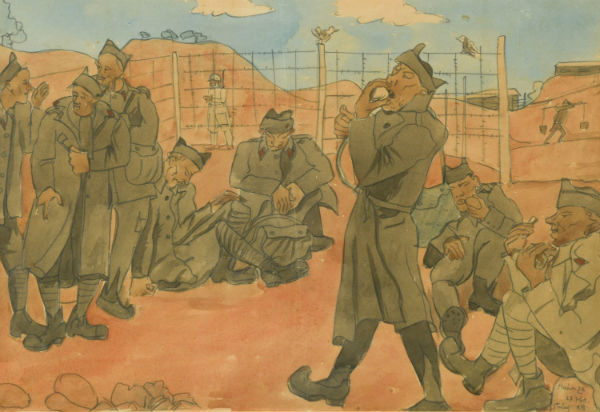
Stalag Scene
Artist information
Name Grégoire Michonze (1902-1982)
Other name Gregoire Michonznic
Born Kishineff, Russia (Kishinev (Bessarabia), Russian Empire (now the Republic of Moldova)
Died Paris, France
Find more work in the collection by this artist
Find out more about this artist
Grégoire Michonze (Michonznic) was born into a Jewish family in Kishinev (Bessarabia) in the Russian Empire (now the Republic of Moldova) on 22 March 1902, and studied at the local art school, where he learned to paint traditional icons in tempera, before going on to study at the Academy in Bucharest. In 1922 he travelled to Paris via Greece, Istanbul and Marseilles, a journey which strongly influenced his later landscape painting. In Paris he entered the École des Beaux-Arts, and met Max Ernst who later introduced him to the Surrealists, notably André Breton, Paul Éluard, and Louis Aragon, though he gradually moved away from their influence to pursue his own personal path as a landscape and figurative artist. In 1924 he met Soutine with whom he developed a strong friendship. Between 1934 and 1936, Michonze exhibited at the Salon des Surindépendants, creating elaborate compositions, which he later described as "Surreal naturalism". In 1937 he moved to New York and Massachusetts, marrying the Scottish artist Una Maclean on his return to France. During the Second World War, he enlisted in the French artillery in 1939, was taken prisoner in June 1940 and held until December 1942 in Stalag XC at Nieburg-on-Weser, 60 km from Bremen in Germany. His wife, Una, remained in Paris in order not to lose contact with him and was subsequently imprisoned in several French camps between January and August 1941, where she continued to receive her husband's letters from Germany. Michonze returned to Paris after his release at the end of 1942. Only in 1946 did he learn that his mother and father had died after being deported and two of his brothers had disappeared. He became a naturalised French citizen in 1947.
He held his first UK show in 1946 at Viennese refugee art dealer Paul Wengraf's Arcade Gallery in London, followed by a second London exhibition at Freddie Mayor's eponymous gallery in 1947. During this period he lived in both England and Scotland and exhibited at the French Institute in Edinburgh and the McClure Galleries in Glasgow (both 1948). During these years (1947-49) his studio on the rue Visconti was occupied by the young sculptor Eduardo Paolozzi during his sojourn in Paris. Michonze showed in Britain again, including as part of the mixed show 'Recent Trends in Realist Painting' at the ICA in 1952, as well as the USA and Israel after his first Paris exhibition in 1953. In 1970 he travelled to Venice and Rome on a painting tour. Grégoire Michonze died in Paris, France on 29 December 1982. The Musée d'Art moderne in Troyes held a major retrospective of his work in 1985. His work is held in the Ben Uri Collection and Glasgow Life Museums in the UK.
Object Details
Date c. 1940-42
Object type painting
Medium watercolour on paper
Materials and techniques watercolour (technique) paper (support)
Unframed 29.5 x 41 cm
Framed 41.2 x 53.5 x 2.3 cm
Signed and numbered (lower right corner): 'Michonze / 67.760 / Stalag XB'
Acquisition purchased 2020
Accession number 2020-02
Display status Not on display
Michonze drew directly on his own experiences in this small but powerful watercolour. After enlisting in the French artillery in 1939, he had been taken prisoner in June 1940 and transferred to Stalag XC at Nienburg-on-Weser, 60 km from Bremen in Germany, until his release in December 1942. Stalag XC housed Prisoners of War (POWs) - ranks below commissioned officers, non-commissioned officers and enlisted men - initially French soldiers, but later Polish, Belgian, Romanian and Serbians were also sent there. In late 1943, following the armistice, they were joined by the Italians. There were also Soviet POWs, who were housed in the easternmost hut, isolated from the others by an additional barbed-wire fence. Held in conditions of great overcrowding, they were also differently treated according to their nationality and status. The Russian prisoners of the Red Army were held in the worst conditions and received the worst treatment: denied POW status, outside food parcels and access to international observers, many died from ill treatment, starvation and disease. Michonze witnessed their sufferings, recording them in other drawings (some later worked up into paintings), and remained haunted by their memory.
The exhausted prisoners shown here however, have been identified by their uniforms, especially their distinctive double peaked caps, as Polish soldiers. Depicted surrounded by barbed wire and guarded by an armed sentry, they huddle in their uniforms in small groups, talking, resting fitfully on the ground or gnawing hungrily at potatoes, while two birds resting lightly on the fence point to the possibility of freedom. Although more realistic than many of Michonze's works, this work shares with them a surreal, naive and allegorical quality.
Keywords
barbed wire | Prisoner of War Camp | Second World War | soldier | Stalag | World War II
Selected exhibition history
2023
Shaping the Future: New Arrivals at the Ben Uri Collection
Ben Uri Gallery
Hover mouse cursor over image to zoom (you can also use the mouse wheel).