Ben Uri Collection

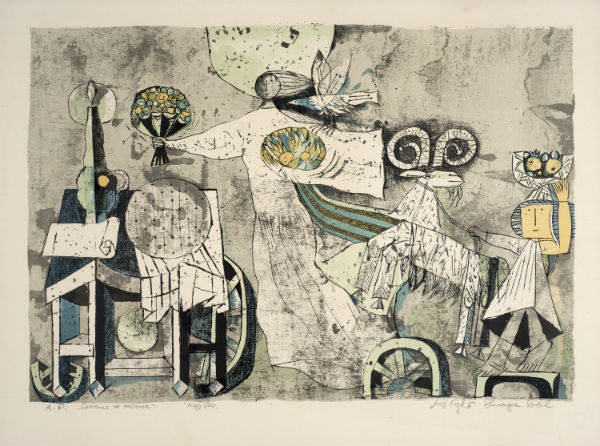
Symbols of Passover
Artist information
Born Nitra, Czechoslovakia
Died Israel
Find more work in the collection by this artist
Find out more about this artist
Printmaker and muralist Shraga Weil was born into a traditional Jewish family in Nitra, Czechoslovakia (now western Slovakia) on 24 September 1918; in 1931 the family moved to Bratislava. After dropping out of Secondary school, Weil worked in the building industry for two years before becoming apprenticed to a local sculptor in Nitra. In 1937, he began studying art in Prague until, following the outbreak of the Second World War, he was forced to flee and spent the war years in Budapest forging papers for the Hungarian underground. In 1943, he was arrested and sent with his wife to a concentration camp, from which he managed to escape in 1944. After the war, Weil designed books for the Hehalutz movement (a Jewish Zionist youth movement that trained young people for agricultural settlement) and in 1948 moved to Israel.
From 1952-53, Weil studied art in Paris, specializing in printmaking, reliefs and wall murals. His early work was similar in style to the socialist art embraced by the Kibbutz Ha’artzi movement. From the 1960s onwards, he began to incorporate Jewish symbols and iconography into his works. In May-June 1962 a joint exhibition of works by Shraga Weil and Melitta Schiffer was held at Ben Uri Gallery in London; Weil also participated in the 50th Anniversary Exhibition (showing an oil version of The Ram) in 1966, and in an exhibition of graphics by Israeli artists in 1970.
Shraga Weil died in Israel on 20 February 2009. His work was represented in two exhibitions at Ben Uri Gallery exploring the legacy of Czech artists in Britain in 1998 and 2019 respectively. Weil is best-known for the entrance doors to the Knesset (1996), the entrance door of the President’s House and the ceramic wall on the facade of the Great Synagogue in Tel Aviv. In the UK his work is represented in the Ben Uri Collection.
Object Details
Object type print
Medium lithography
Materials and techniques ink (medium) lithography (technique) paper (support)
Unframed 46.5 x 61 cm cm
Acquisition Presented by Mrs. Alice Schwab
Accession number 1987-426a
Display status not on display
From the 1960s onwards, Weil began incorporating Jewish symbols and iconography into his work. The sacrificial or Paschal lamb was traditionally slaughtered on the eve of Passover and eaten on the first night of the Jewish Passover holiday with bitter herbs and matzo. Weil is best-known for his architectural door designs for the Knesset building's main entrance and the President's residence, and the Tel Aviv Great Synagogue's ceramic walls.
Selected exhibition history
2019
Czech Routes: Selected Czechoslovakian Artists in Britain
Ben Uri Gallery
Literature
Nicola Baird ed., Czech Routes: Selected Czechoslovak Artists in Britain from the Ben Uri and Private Collections (London: Ben Uri Gallery, 2019); Walter Schwab and Julia Weiner, eds., Jewish Artists: the Ben Uri Collection - Paintings, Drawings, Prints and Sculpture (London: Ben Uri Art Society in association with Lund Humphries Publishers Ltd, 1994), p. 105.
Hover mouse cursor over image to zoom (you can also use the mouse wheel).