Ben Uri Collection

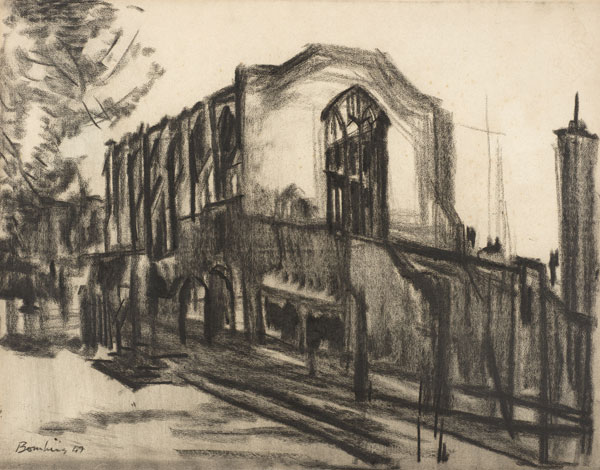
Benchers Hall, Inner Temple
Artist information
Name David Bomberg (1890-1957)
Born Birmingham, England
Died London, England
Find more work in the collection by this artist
Find out more about this artist
David Bomberg was born to Polish-Jewish parents in Birmingham, England on 12 May 1890. The family moved to Whitechapel in 1895, where he later became prominent among the ‘Whitechapel Boys’ - the term applied to a loose, informal group of young, Jewish, mainly immigrant artists who were either born, raised or worked in the East End in the first two decades of the 20th century, and who, both collectively, and individually, made an important contribution to British Modernism. Initially apprenticed as a chromolithographer, he attended night classes under Walter Sickert and also worked as an artist’s model before studying at the Slade School of Fine Art, where he was seen as a ‘disturbing influence’. In 1913 Bomberg visited Paris with Jacob Epstein, making contact with artists including Modigliani and Picasso. Bomberg’s harrowing service in the trenches during the First World War was compounded by a disastrous experience as a commissioned war artist, explored in a series of related drawings. His postwar disillusionment is most powerfully expressed in the masterly Ghetto Theatre (1920), purchased the same year for the Ben Uri Collection, initiating a lifelong relationship. Afterwards Bomberg made a series of peopled landscapes before travelling in 1923 to Jerusalem, where he began to work en plein air for the first time. Following expeditions to Jericho, Petra and Wadi Kelt, he produced a series of detailed, realistic landscapes, which evolved from tightly topographical treatments into a looser, characteristically expressionistic style, heralding the painterly achievements of his final years.
After a series of disappointments in the 1930s and 1940s Bomberg concentrated on portraits of friends and family, as well as a series of searching self-portraits. Although only reluctantly granted a Second World War commission to paint a bomb store in 1942, Bomberg produced many drawings and paintings on the subject, among them an impressive, large-scale study for a projected (but unrealised) mural. Following his visit to Spain in 1929, a renewed vigour resulted in a series of works based on the cathedral at Toledo, flowering on his second visit in 1934–35, into dramatic landscapes of the gorge at Ronda and flickering night-time processions during Holy Week. These experiments were curtailed by the onset of the Spanish Civil War, but over a decade later picked up and progressed in the west country, where his loosened handling verged on the abstract, and in Cyprus in 1948. His final works culminated in the fulfillment of his early promise after his return to Ronda, where he spent his last years. After becoming seriously ill, Bomberg travelled back to England, but died in London shortly after his return, on 19 August 1957. His work is represented in the UK in a number of important public collections including the Ben Uri Collection, the British Museum, the Imperial War Museum, the Tate, and the V&A. A posthumous touring exhibition (Pallant House, Chichester; Laing Art Gallery, Newcastle; Ben Uri Gallery, London), accompanied by a monograph, was organised by Ben Uri in 2017-18.
Object Details
Date 1947
Object type drawing
Medium charcoal on paper
Materials and techniques charcoal (medium) paper (support)
Unframed 47 x 60 cm
Framed 61 x 75 x 3 cm
Signed (lower left): 'Bomberg 47'
Acquisition presented from private collection, 2015
Accession number 2015-02
Display status not on display
Bomberg remarked, ‘There is no fixed way in which a line goes, but there is a relationship between lines’. This is one of a series of drawings of the Inns of Court that he completed in the mid- to late forties during the period when he began his career as a highly influential teacher. Towards the end of the war he took over a post as drawing master at the Bartlett School of Architecture prior to his appointment at the Borough Polytechnic (1946–53) where he taught Gustav Metzger, Frank Auerbach and Leon Kossoff among many others. Bomberg’s teaching also strengthened and informed his own work. Here he uses strong, fluid charcoal strokes to trace the outline of the building to evoke a sense of mass – an important concept in both his practice and his teaching.
Keywords
architecture | church | drawing | London | urban
Selected exhibition history
2015
No Set Rules: A Century of Selected Works from the Schlee Collection, Southampton, and the Ben Uri Collection, London
Ben Uri Gallery
2019
Friends and Influences: Auerbach, Freud, Kitaj, Kossoff, Bomberg; Chagall, Soutine, Marevna
Ben Uri Gallery
2021
Becoming Gustav Metzger: Uncovering the Early Years, 1945-59
Ben Uri Gallery & Museum
Literature
Nicola Baird, ed., Becoming Gustav Metzger: Uncovering the Early Years 1945-59 (London: Ben Uri Research Unit, 2021), p. 40; Sarah MacDougall and Rachel Dickson, Bomberg (London: Ben Uri Gallery, 2017) p.170, illus; Sarah MacDougall, ed., No Set Rules: A Century of Selected Works from the Schlee Collection, Southampton, and the Ben Uri Collection, London (London: Ben Uri Gallery, 2015), pp. 38-39, illus.
Hover mouse cursor over image to zoom (you can also use the mouse wheel).