Ben Uri Collection

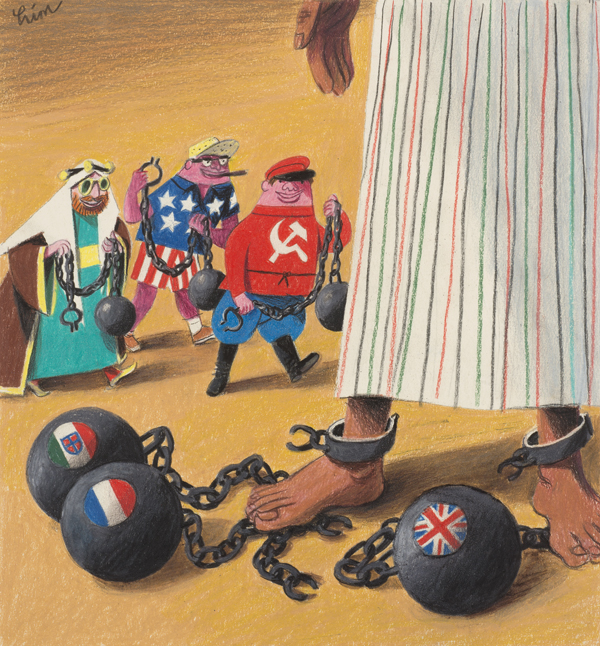
Israel and the World Powers
Artist information
Other name Jerzy Himmelfarb
Born Łódź, Poland
Died London, England
Find more work in the collection by this artist
Find out more about this artist
Illustrator and graphic designer George Him (né Jerzy Himmelfarb) was born into a Jewish family in Łódź, Poland on 4 August 1900. He was educated in Warsaw, Moscow, and Bonn, before attending Leipzig Academy for Graphic Art in 1924, and commencing work as a graphic designer two years later. He returned to Poland, where he was active in graphic art circles and in 1933 began a collaboration with Jan Le Witt (1907–1991), also shortening his own name to George Him. Working as Lewitt-Him, they established a distinctive design style, which combined cubist and surrealist elements, often in a humorous context; their partnership lasted for twenty years.
In 1937 they relocated to London, where they produced information and public safety posters for the Ministry of Information, the London Transport and the General Post Office during the Second World War. Postwar, Him worked on projects including the exhibition ‘Britain can make it’ (1946) and the Festival of Britain (1951), producing murals for the Education Pavilion and designing the Festival Clock at the Pleasure Gardens in Battersea Park. After 1948, he was also active in projects in Israel. Him resumed working independently from 1955, receiving commissions from continental Europe and the USA, including designing the 1961 Warsaw Ghetto exhibition (shown in London and Frankfurt). Three retrospective exhibitions of his work were organised, two within his lifetime: in 1976 (the London College of Printing) and 1978 (Ben Uri Gallery), respectively. Him was appointed Fellow of the Society of Industrial Artists, Fellow of the Society of Typographical Designers, and a Royal Designer for Industry in 1978. He died in London, England on 4 April 1982. His work is held in UK collections including the Imperial War Museum and the Victoria & Albert Museum; most recently, a retrospective was held at the House of Illustration in London in 2020.
Object Details
Date c. 1956
Object type drawing
Medium coloured pencil on paper
Materials and techniques pencil (medium) paper (support)
Unframed 32.7 x 32.2 cm
Signed (upper left): 'Him'
Acquisition Presented by Agi Katz
Accession number 2014-14
Display status not on display
This cartoon was published with the title 'The New Colonialists' on the cover of the magazine The New Middle East in 1956. Him employed universally recognised symbols, such as Arab dress, the American Stars and Stripes and the Russian Hammer and Sickle to construct a troubling narrative concerning the future of the State of Israel. The artist and Illustrator, David Gentleman, wrote in Him’s obituary that his work was ‘always adventurous, humorous and elegant; but it also had a simple and unassuming, almost childlike air’ that ‘seemed to belie his breadth of vision and understanding.’
Selected exhibition history
2017
Art Out of the Bloodlands: A Century of Polish Artists in Britain
Ben Uri Gallery
Literature
Rachel Dickson, ed., From Adler to Zuławski: A Century of Polish Artists in Britain (London: Ben Uri Research Unit, 2020), p. 67 (illus. included).
Hover mouse cursor over image to zoom (you can also use the mouse wheel).