Ben Uri Pre-Eminent Collection

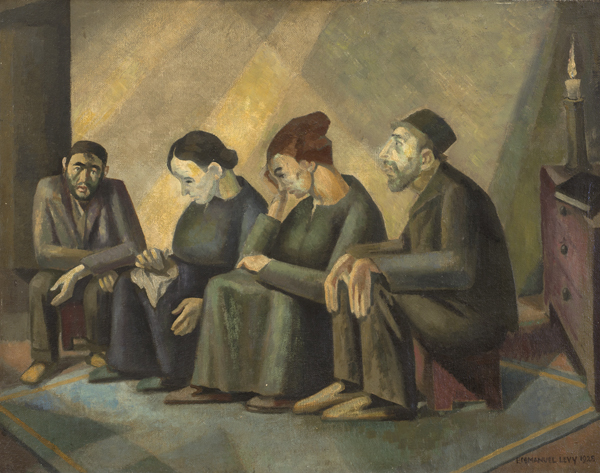
The Mourners (Sitting Shiva)
Artist information
Name Emmanuel Levy (1900-1986)
Born Manchester, England
Died London, England
Find more work in the collection by this artist
Find out more about this artist
Emmanuel Levy was born to Russian-Jewish immigrant parents in Hightown, Manchester, England in 1900. Like Jacob Kramer, he was one of a small group of Jewish artists, whose families, fleeing persecution, restrictive legislation and economic hardship settled in the north of England as part of a wider wave of Jewish migration to Britain at the close of the nineteenth century. Hightown was immortalized by the Jewish writer Louis Golding in his best-selling novel Magnolia Street (1932), which Levy later adapted as a radio play. His father was the beadle at the Great Synagogue, Cheetham Hill and he attended the local Jews’ Free School, before studying at Manchester School of Art under Adolphe Valette between 1919 and 1922, together with L. S. Lowry (whose portrait he drew), as well as at St Martin’s School of Art in London, and in Paris. He returned to Manchester for his first solo show in 1925. His early work included Jewish subject matter, such as The Mourners (Sitting Shiva) (1928, Ben Uri Collection), executed in a semi-Cubist manner. In 1928 Levy was appointed a special instructor in life drawing at Manchester University School of Architecture upon the recommendation of Valette, whom he succeeded. He also gave popular public demonstrations in portrait painting. From 1929, for several years, he was Art Critic for Manchester City News and the Evening News and his 60-year career was so closely associated with his native city that Lord Ardwick described him as ‘a Manchester man through and through. But’, he continued, ‘there is nothing provincial or even distinctly English in his work. He is a citizen of the world’.
Although he experimented with Cubism and Surrealism, Levy abandoned these styles in favour of naturalism, specializing in figurative work exploring the human condition. His wife, Ursula Leo (1915–1984), one of his pupils and a painter in her own right, was a German-Jewish refugee from Nazism and during the Second World, he painted ‘Crucifixion’ (1942), a cri-de-coeur against Jewish persecution under the Nazis in mainland Europe. He held six solo exhibitions in Manchester between 1925 and 1963, with further solo shows in London, including at Ben Uri (1953, 1978 and 1989), where his work was also shown from 1935 onwards in numerous group shows; a further solo show was held in Brunner, Norwich in 1952.. Retrospectives were held at Salford City Art Gallery (1948), Fieldborne Galleries, London (1976) and Stockport Art Gallery (1982). He also exhibited with the AIA (Artists' International Association) including in 1953 and 1954.
Emmanuel Levy died in London, England in 1986. His work is represented in UK Collections including the National Portrait Gallery, Manchester Art Gallery, Salford Museum and Art Gallery and the Whitworth. In 2014 Ben Uri Gallery curated a posthumous retrospective, Made in Manchester: Emmanuel Levy, at Manchester Jewish Museum.
Object Details
Date 1928
Object type painting
Medium oil on canvas
Materials and techniques oil (medium) painting (technique) canvas (support)
Unframed 72.5 x 91 cm
Framed 88.8 x 108.6 x 3 cm
Signed (lower right) Emmanuel Levy 1928
Acquisition presented by the Estate of Victoria Sternfield 2014
Accession number 2014-07
Display status not on display
Levy painted this moving work in 1928 following the death of his father, the former beadle of the Old Congregation in Cheetham Hill Road. It invokes the Jewish ceremony of Sitting Shiva in which members of the immediate family gather (usually in the deceased’s home) to mourn for seven days following the burial. The shallow picture space and hard-edged figures show an awareness of Cubism, which Levy later rejected in favour of naturalism. According to his close friend Bernard Sternfield, the artist always considered this ‘his major work’. Commenting on the painting, in the 1950s, Levy observed that, 'Though the subject is essentially Jewish in character and the figures imaginary, the artist hopes its appeal will have deeper and more universal significance. Its 'cubistic' form is meant to convey, not only technical and aesthetic considerations, but also, and mainly, a feeling of rock-like permanance, which after all, is what suffering is - eternal' (Emmanuel Levy, cited Exhibition of Jewish Artists, McLellan Galleries, Glasgow, 1951, cat. no. 54).
Selected exhibition history
1951
Exhibition of Jewish Artists
Mclellan Galleries
1953
Paintings by Emmanuel Levy
Ben Uri Art Gallery
1978
Jewish Artists of Great Britain 1845-1945
Belgrave Gallery
1978
Jewish Artists of Great Britain 1845-1945
Cartwright Hall Art Gallery and Museum
1989
Emmanuel Levy 1900-86 - A Memorial Exhibition
Ben Uri Gallery
2014
Made in Manchester: The Art of Emmanuel Levy (1900-1986)
Manchester Jewish Museum
Literature
Jewish Artists of Great Britain 1845-1945 (London: Belgrave Gallery Ltd, 1978), p. 40, cat no. 49, illus., p. 41; Emmanuel Levy, Exhibition of Jewish Artists (Glasgow: McLellan Galleries, Glasgow, 1951), cat. no. 54.
Hover mouse cursor over image to zoom (you can also use the mouse wheel).