Ben Uri Collection

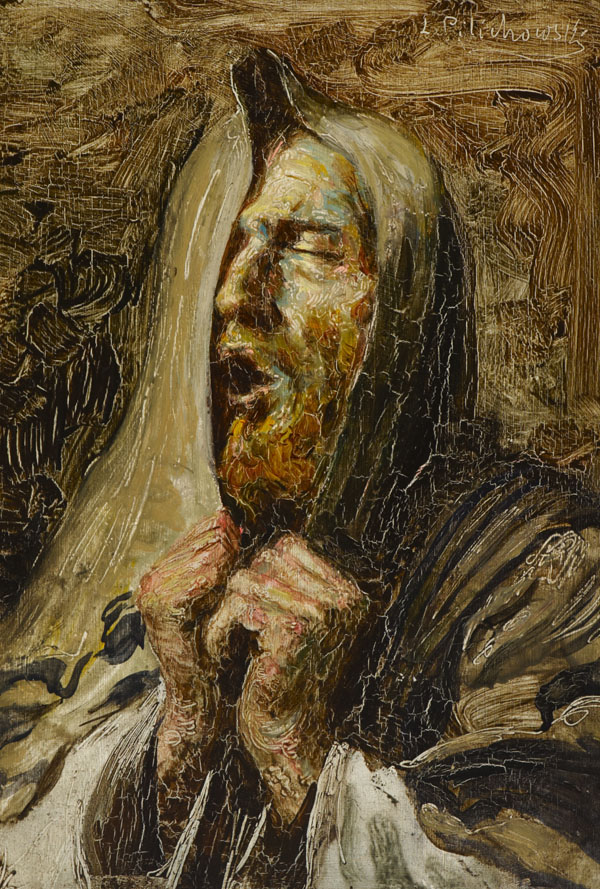
Hear O Israel
Artist information
Name Leopold Pilichowski (1866-1933)
Other name Lajb Pilichowski, Levek Pilichowski
Born Pila, Poland
Died London, England
Find more work in the collection by this artist
Find out more about this artist
Leopold Pilichowski was born into a Jewish family of farmers in Pila, near Sieradz, Poland on 23 March 1869. He was taught to draw by the painter Samuel Hirszenberg (to whom he was distantly related), and studied at the Art Academy in Munich and later at the Academy Julian in Paris, holding his first exhibition in Łódź in 1894. Around 1895 he began to address Jewish themes in his work, particularly the poverty of Jews in the cities. This commitment to social commentary led him to depict Jewish immigrants, wanderers and pedlars. He exhibited in Paris from 1899 onwards, studying with Benjamin Constant and moving to the city with his wife, Lena Pillico, around 1904 (he later received the Legion of Honour from the French government in 1927), exhibiting there, as well as in London, New York and Warsaw. In 1906 his work was included in the exhibition of Jewish Art and Antiquities at the Whitechapel Art Gallery in London, as well as in an exhibition of works by Jewish artists in Cracow and in 1907 he helped to co-organise an exhibition of Jewish Artists at the Gallery for Ancient and Modern Art in Berlin including his own work on the subject of exile. From 1908 Pilichowski was an active Zionist and probably his most famous portrait is one of the Zionist leader Theodor Herzl, painted in the same year and which is believed to exist in two versions (one in the Central Zionist Archives, Jerusalem; another in the Ben Uri collection).
A decade later, in 1913, at the age of 45, he moved to London, with his wife (the artist Lena Pillico) and their children, aided by Hebrew writer David Frishman. He travelled frequently between Paris and Łódź in 1914 and upon his return to London, concentrated on painting the impoverished Jews of Whitechapel. He lectured at the Ben Uri Art Society in 1916, and, again, in 1921, becoming Hon. President in 1926 – a position he held until 1933. In 1925 he depicted Lord Balfour delivering his speech among a crowd at the inauguration of the Hebrew University at Mount Scopus, Jerusalem and in 1927, reflecting on his visit, he lectured at Ben Uri on 'Palestine As Seen By An Artist', describing the close connection of the Jewish soul and spirit to the holy city of Jerusalem. He also served as president of the Association of Polish Jews in London. An 'Exhibition of portraits, landscapes, Jewish life studies, &c. by Leopold Pilichowski' was held at the Goupil Gallery, London in 1924 and he also participated (as did his wife, Lena Pillico) in the important survey exhibition 'Jewish Art and Antiquities' at the Whitechapel Art Gallery in 1927. In 1928 husband and wife were both also among the 16 artists who exhibited work at the Brooklyn Museum exhibition of 'Paintings, Sculpture and Drawings by American and European Artists' with Pilichowski showing 17 paintings (including a portrait of British Conservative politician Lord Balfour, architect of the 'Balfour declaration') to 29 by Pillico. In 'The Catalogue and Survey of Activities', published by the Jewish Art and Literary Society Ben-Uri in 1930, it was recorded that 'Mr. Pilichowski is one of the most popular Jewish painters of the older generation, and is at the present time, the President of the Ben Uri. Mr. Pilichowski, as already alluded to, has been of great assistance to the Society by reason of his expert advice and lectures on Jewish art which always attract large and eager audiences'. The minutes for 1931 refer to his donation of 30 pictures, at a nominal charge, including those by Josef Israels, Leopold Gottlib, Hermann Struck and Leon Hirszenberg.
Leopold Pilichowski died in London, England on 29 July 1933 and is buried in Willesden United Synagogue cemetery. Much of his oeuvre was destroyed by bombing during the Second World War. Surviving examples of his work are held in the Ben Uri Collection in the UK and in collections abroad including the Louvre, Paris; National Museums of Crakow and Warsaw; the City Museum of Łódź; and the Jewish Museum, New York.
Object Details
Object type painting
Medium oil on board
Materials and techniques oil (medium) painting (technique) board (support)
Unframed 29 x 20 cm
Framed 45 x 36.5 cm
Signed (upper right): 'L. Pilichowski'
Acquisition purchased 1924
Accession number 1987-314
Display status not on display
Pilichowski depicts an observant Jewish man in the act of reciting the Shema or Jewish confession of faith, which begins: 'Hear, O Israel: The Lord our God, the Lord is one! You shall love the Lord your God with all your heart, with all your soul, and with all your strength' (Deuteronomy 6: 4-9). He is dressed in traditional ritual prayer garments that indicate modesty before god, including a tallit gadol (large prayer shawl) that covers his head and a tefillah shel rosh (head tefillah), just glimpsed beneath on his forehead. The artist focuses on his subject's closed eyes, open mouth and raised hands to indicate his devotion. The neutral palette is relieved by touches of colour in the fleshtones of the face and hands and the red beard. The background is indicated by broad, swirling brushstrokes that also reflect the sitter's inner emotions.
The Catalogue and Survey of Activities, published by the Jewish Art and Literary Society Ben-Uri in 1930, records that 'In 1924, when Pilichowski held an exhibition of his pictures in London, the Ben Uri purchased his well-known painting, 'Hear O Israel'. It was included in the inaugural exhibition marking the Official opening of the Ben-Uri Gallery and Club, Great Russell Street and recorded in the catalogue as cat no. 26.
Keywords
faith | Jew | Judaic | Judaism | man | prayer | prayer shawl | shema | tallit gadol | tefillah shel rosh (head tefillah) | tefillin
Selected exhibition history
1925
Official Opening at Great Russell Street
Ben-Uri Jewish Art Society Gallery and Club
1927
Exhibition of Jewish Art and Antiquities
Whitechapel Art Gallery
1930
Mansell Street Gallery Opening: Catalogue and Survey of Activities
Jewish Art and Literary Society Ben-Uri
1934
The Opening of the Ben Uri Jewish Art Gallery and an Exhibition of Works by Jewish Artists
Ben Uri Jewish Art Gallery
1935
Israel Zangwill Memorial Exhibition
Ben Uri Jewish Art Gallery
1944
Opening Exhibition
Ben Uri Art Gallery
1945
Exhibition of Paintings by A. A Wolmark (Konstam Collection), Dobrinsky Paris, and a selection of work from the Ben Uri Collection
Ben Uri Art Gallery
1946
Selections from the Ben Uri Permanent Collection of Paintings, Sculpture & Drawings
Ben Uri Art Gallery
1946
Subjects of Jewish Interest: Paintings, Sculpture & Drawings
Ben Uri Art Gallery
1948
Exhibition of Jewish Art
North Western Reform Synagogue
1954
Exhibition of Jewish Art
Hove Museum of Art
1990
Ben Uri Highlights: Key Works and Figures
Ben Uri Art Society
1997
The Art of Prayer: Featuring Rabbis, Scholars and Scribes
Etz Chayim Gallery
2009
Homeless & Hidden 1: World Class Collection Homeless & Hidden
Ben Uri Gallery
Literature
Oil Paintings in Public Ownership in Camden (London: The Public Catalogue Foundation, 2013), p. 32 (illus. included); Walter Schwab and Julia Weiner, eds., Jewish Artists: the Ben Uri Collection - Paintings, Drawings, Prints and Sculpture (London: Ben Uri Art Society in association with Lund Humphries Publishers Ltd, 1994), p. 84; Catalogue and Survey of Activities: Jewish Art and Literary Society Ben-Uri (London: Ben Uri, 1930), illus.
Hover mouse cursor over image to zoom (you can also use the mouse wheel).