Ben Uri Collection

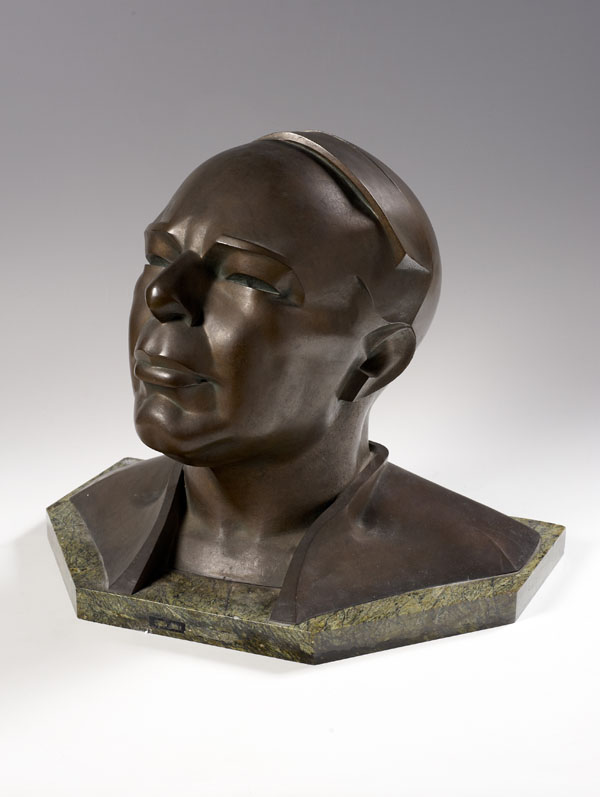
The Rt Hon. Leslie Hore-Belisha
Artist information
Other name Beniamin Kujawski
Born Ryki, Poland
Died Jerusalem, Israel
Find more work in the collection by this artist
Find out more about this artist
Sculptor Zeev Ben-Zvi (Beniamin Kujawski) was born into a Jewish family in Ryki, Poland in 1904 and studied at the Academy of Art in Warsaw before immigrating to Palestine in 1924. After working for two years with Boris Schatz (1866–1932), founder of the Bezalel Academy of Arts and design in Jerusalem, Ben-Zvi taught sculpture at Bezalel from 1926–7, subsequently holding a teaching post there intermittently until his death. Ben-Zvi’s early naturalistic style gave way to a more intense expression based on Cubist techniques and he became known for his portrait sculptures and his masks from beaten copper. His work influenced a subsequent generation of sculptors.
Ben-Zvi lived in England from 1937–9, where he began to use more rounded forms and to minimise detail, as can be seen in his head of Lord Hore Belisha, exhibited at the Royal Academy in summer 1938 and admired in the 'Western Morning News' (02 May 1938) as 'a simplified faithful likeness' of the Secretary of State for War. In the same year he had a notable solo exhibition at the newly founded Bond Street gallery of German-Jewish refugee art dealer Francis (né Franz) Matthiesen (1898–1963). During the Second World War his work became more abstract. After his return to Jersualem he became a lecturer at Bezalel and created a monumental sculpture at Mishmar Haemek, In Memory of the Children of the Diaspora (1947), which has been described as ‘the apogee of Israeli monumental sculpture’. Zeev Ben-Zvi died in Jerusalem in 1952. In 1953 he posthumously received both the Dizengoff Prize and the inaugural Israel Prize for Sculpture. His work is represented in the UK in the Ben Uri Collection.
Object Details
Date c. 1938
Object type sculpture
Medium bronze on marble base
Materials and techniques bronze (medium) sculpture (technique)
Dimensions 44.5 x 31 x 40 cm
Acquisition presented in 1959
Accession number 1987-30
Display status not on display
The subject of this portrait head, (Isaac) Leslie Hore-Belisha (1893–1957), became a Liberal MP in 1923 and helped to form the National Liberal Party 1931 in support of the national coalition. As Minister of Transport (1934–37), he gave his name to the ‘Belisha beacon’ on pedestrian crossings and was responsible for introducing the 30 mph speed limit. As British Secretary of State for War (1937–40), he instituted military conscription in the spring of 1939, a few months before the outbreak of hostilities, but lost his post in 1940.
Sculptor Zeev Ben-Zvi lived in England between 1937 and 1939, featuring in Ben Uri’s annual exhibition of 1937 and having a notable one-person exhibition at the Matthiesen Gallery in London in 1938. At this time he began to use more rounded forms and to minimise detail, as can be seen in his head of Lord Hore-Belisha, which was exhibited at the Royal Academy in 1938 and admired as s ‘an almost eerie combination of realism and the modern style' (Hannen Swaffer, ‘Best Thing in Academy Is Not A Picture’, Daily Herald, 30 April 1938, p. 6 ) and the 'Western Morning News' (02 May 1938) as 'a simplified faithful likeness' of the Secretary of State for War. It was also included in Ben-Zvi’s solo exhibition at German-Jewish refugee art dealer Francis Matthiesen's gallery in December 1938, and praised in the Daily Herald for the ‘character and spirit’ conveyed (Stuart Fletcher, Daily Herald, 8 December 1938, p. 5). During the 1940s Ben-Zvi’s work became more abstract. His sculpture continued to feature in Ben Uri loan exhibitions, including the 1944 Opening Exhibition and the 1953 Coronation Exhibition of Paintings and Sculpture; the latter was characterised, according to the catalogue, as being ‘European rather than British’. After his return to Jerusalem, he became a lecturer at Bezalel and his work included monuments.
Selected exhibition history
1938
Royal Academy Summer Exhibition
Royal Academy
1938
Sculpture by Zeev Ben-Zvi
Matthiesen Ltd
1944
Opening Exhibition
Ben Uri Art Gallery
1945
Exhibition of Paintings by A. A Wolmark (Konstam Collection), Dobrinsky Paris, and a selection of work from the Ben Uri Collection
Ben Uri Art Gallery
1946
Selections from the Ben Uri Permanent Collection of Paintings, Sculpture & Drawings
Ben Uri Art Gallery
1954
Exhibition of Jewish Art
Hove Museum of Art
2008
Israel & Art: 60 Years through Teddy's Eyes
Ben Uri Gallery
2009
Homeless & Hidden 2: World Class Collection Homeless & Hidden
Ben Uri Gallery
2011
Bonhams Israeli
Bonhams
2015
Out of Chaos – Ben Uri: 100 Years in London
Somerset House
2023
A Brush with Evil: Peter Howson's Holocaust Crowd Scene II
Ben Uri Gallery
2024
Cosmopolis: The Impact of Refugee Art Dealers in London
Ben Uri Gallery
Literature
Rachel Dickson and Sarah MacDougall, eds., 'Out of Chaos: Ben Uri; 100 Years in London' (London: Ben Uri Gallery, 2015) pp. 84-85.; David Bonan, ed., Israel & Art: 60 years through the eyes of Teddy Kollek (London: Ben Uri Gallery, 2008); Walter Schwab and Julia Weiner, eds., Jewish Artists: the Ben Uri Collection - Paintings, Drawings, Prints and Sculpture (London: Ben Uri Art Society in association with Lund Humphries Publishers Ltd, 1994), p. 24.
Hover mouse cursor over image to zoom (you can also use the mouse wheel).