Ben Uri Collection

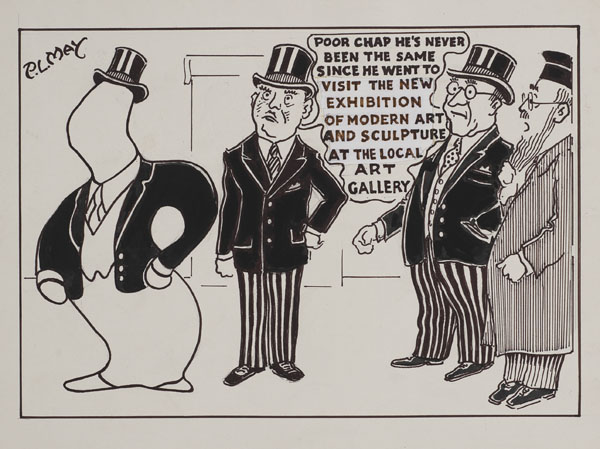
'Poor chap, he's never been the same since'
Series: PL May cartoon portfolio
Artist information
Name Phineas Leopold May (1906-1995)
Born Essex, England
Died London, England
Find more work in the collection by this artist
Find out more about this artist
Phineas Leopold May was born into a Jewish family, the son of a naturalised German father and an English mother, in Essex, England on 9 May 1906. At the age of fifteen, he took a postal course at the London School of Cartoonists and later studied part-time at the Central School of Art. He was involved in Jewish communal service from 1935 onwards and later Custodian of the Jewish Museum in London until 1991.
In 1939 Phineas May and his brother Jonas were appointed by the Central British Fund for German Jewry to create and administer the Kitchener Camp at Richborough, near Sandwich in Kent, a disused First World War army camp. 4000 transmigrant young men came to the camp waiting for permanent settlement overseas. The whole rescue was funded by the British Jewish Community with help from American Jewry. Professor Norman Bentwich negotiated the immigration technicalities with the British authorities. During the Second World War most of them volunteered to fight for the Allies. May also served in the British Army in the Second World War and produced some 400 cartoons, now in the Imperial War Museum.
Phineas May was a member of Hampstead Synagogue and was the Shul's administrator from 1960 to his retirement in 1971. He also served as a member of Ben Uri's Council from 1974–93. He published 'A Cartoon History of Anglo-Jewry' in 1980. Phineas May died in London, England in 1995.
Object Details
Object type drawing
Medium pencil, pen and ink on paper
Materials and techniques ink | pen (medium) paper (support)
Unframed 22.8 x 29.2 cm
Signed (upper left): P. L. May
Acquisition presented by the artist 1987
Accession number 1987-279b-ix
Display status not on display
May's witty caricature depicts two well-dressed businessmen and a rabbi (in a typical biretta-style hat), discussing the 'poor chap', who has irreversibly changed after a visit to an exhibition of modern art. In keeping with his conversion to the modern, the latter's facial features have disappeared and his body has been simplified to resemble an almost abstract form; his arm, encircles a distinct circular negative space, reminiscent of that found in sculptures by Barbara Hepworth and Henry Moore in this period.
Selected exhibition history
2023
The Second World War on the Home Front (supporting A Brush with Evil II: Laura Knight at the Nuremberg Trial)
Ben Uri Gallery
Literature
Walter Schwab and Julia Weiner, eds., Jewish Artists: the Ben Uri Collection - Paintings, Drawings, Prints and Sculpture (London: Ben Uri Art Society in association with Lund Humphries Publishers Ltd, 1994), p. 77.
Hover mouse cursor over image to zoom (you can also use the mouse wheel).