Ben Uri Collection

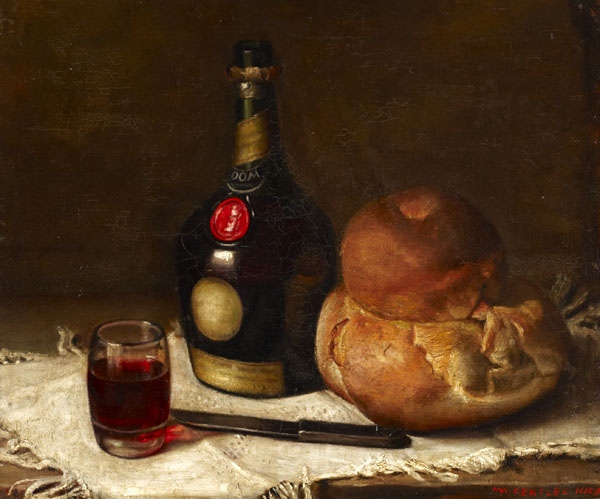
Still Life with a Bottle of Benedictine
Artist information
Born Spitalfields, London, England
Died Hampstead, London, England
Find more work in the collection by this artist
Find out more about this artist
Mark Gertler was born the fifth and youngest child of Austrian-Jewish immigrant parents in Spitalfields, London, England on 9 December 1891. During a period of economic downturn, the family was repatriated to Przemyśl, Galicia, then in the Austro-Hungarian empire (now Southern Poland), the following year. After his father's departure to seek work in America, the family lived on the brink of starvation until eventually they were reunited in London in 1896. Following a brief apprenticeship at Clayton and Bell stained-glass makers, and evening classes at the Regent School Polytechnic, Gertler entered the Slade School of Fine Art in 1908, with a loan from the Jewish Education Aid Society; twice winning the Slade scholarship and leaving with another from the British Institution in 1911. He began exhibiting while still a student with Vanessa Bell's Friday Club in 1910, had a joint show with John Currie at the Chenil Galleries, Chelsea in 1912, and began showing with the New English Art Club the same year. In 1914 his work was included in the so-called 'Jewish Section', co-curated by Bomberg and Jacob Epstein at the exhibition ‘Twentieth Century Art: A Review of Modern Movements’ at the Whitechapel Art Gallery. He was turned down for military service during the First World War, firstly on the grounds of his 'Austrian' parentage, then later, after being called up in 1918 was excused active service on the grounds of ill health and not forced to publicly declare his pacifist convictions, which were instead expressed in his anti-war painting Merry-Go-Round (1916, Tate). Although offered a commission as a war artist, after an attack of depression, he left it unfulfilled.
Gertler was a leading member of the London Group from 1915 onwards, exhibited with Roger Fry’s Omega Workshop in 1917 and 1918 and participated regularly in the Goupil Salons (1915-37). He had five solo shows at the Goupil Gallery, London (1921, 1922, 1923, 1924 and 1926), but tuberculosis, first diagnosed in 1920, seriously undermined his health, frequently confining him to sanatoria: from November 1920 until May 1921, and then again, in 1925, 1929 and 1936. He had six further solo shows in his final decade: at the Leicester Galleries, London (1928, 1930, 1932 and 1934) and at the Lefevre Galleries, London in 1937 and 1939; from 1934, until its closure on the eve of the Second World War, he also taught part-time at the Westminster School of Art. In 1934 and 1937 his work was also included in group shows at the Ben Uri Gallery.
Suffering from ill health and depression, Gertler committed suicide on 23 June 1939. Memorial exhibitions were held at the Leicester Galleries in 1941, Ben Uri Gallery in 1944 and Whitechapel Art Gallery in 1949. Posthumous solo exhibitions have been held at The Minories, Colchester, and tour (1971), Camden Arts Centre (1992), and Ben Uri Gallery, London (1982, 2002 and 2019), with a further show at Piano Nobile Gallery (2012) and a Tate room display in 2018. His work is held in more than 40 UK collections including the Ben Uri Collection, the British Museum, the National Portrait Gallery, Southampton City Art Gallery, the Tate and the V&A.
Object Details
Date 1908
Object type painting
Medium oil on canvas
Materials and techniques oil (medium) canvas (support)
Unframed 41 x 48 cm
Framed 56.5 x 64 cm
Signed and dated (lower right): M. Gertler 1908
Acquisition on long-term loan from R. J. Morris
Accession number 1987-114
Display status not on display
Perhaps originally inspired by a Friday-night eve of Sabbath supper, this early still-life was probably created towards the end of Gertler’s brief training at the Regent Street Polytechnic (1906-8), before he began at the Slade School of Art. It relates closely to the Study of a Still Life in the National Gallery, signed ‘Chardin. 1754’, but now recognised as by a nineteenth-century imitator. It was painted at a time when Gertler greatly admired the old masters of Dutch realism, and its later followers including Jean-Simeon Chardin, and began to ‘haunt’ the rooms of the National Gallery, crafting his own pictures in their image. These simple kitchen scenes appealed to Gertler because of their familiarity. These were the objects he found in his mother’s kitchen (where he had his first studio) and his close relationship with his mother is also reflected in his choice of everyday subject matter. Gertler later recalled the painting of these ‘simple and loveable little still lives’ in his mother’s kitchen as among his finest moments. The round loaf depicted resembles a Challah loaf, now closely associated with the festival of Rosh Hashana (the Jewish New Year), with the spiral rounds thought to symbolise the continuity of creation.
Keywords
bottle | bread | Jewish Festival | kitchen | painting | Rosh Hashana | Sabbath | still life
Selected exhibition history
1982
Mark Gertler: The Early and the Late Years
Ben Uri Art Gallery
1992
Jewish Artists at the Slade: Auerbach, Bomberg, Cohen, Gertler (and recent acquisitions)
Ben Uri Gallery
2002
Mark Gertler: A New Perspective
Ben Uri Gallery - The London Jewish Museum of Art
2003
Director's Choice: Highlights from the Ben Uri Permanent Collection
Ben Uri Gallery - The London Jewish Museum of Art
2009
Homeless & Hidden 1: World Class Collection Homeless & Hidden
Ben Uri Gallery
2018
Exodus: masterworks from the Ben Uri Collection
Bushey Museum
2019
Migrations: masterworks from the Ben Uri Collection
Gloucester Museum
Literature
Oil Paintings in Public Ownership in Camden (London: The Public Catalogue Foundation, 2013), p.15 (illus. included); Mark Gertler A New Perspective, (London: Ben Uri Gallery, 2002) p.6 (illus. included); Walter Schwab and Julia Weiner, eds., Jewish Artists: the Ben Uri Collection - Paintings, Drawings, Prints and Sculpture (London: Ben Uri Art Society in association with Lund Humphries Publishers Ltd, 1994), p. 46.
Hover mouse cursor over image to zoom (you can also use the mouse wheel).