Ben Uri Collection

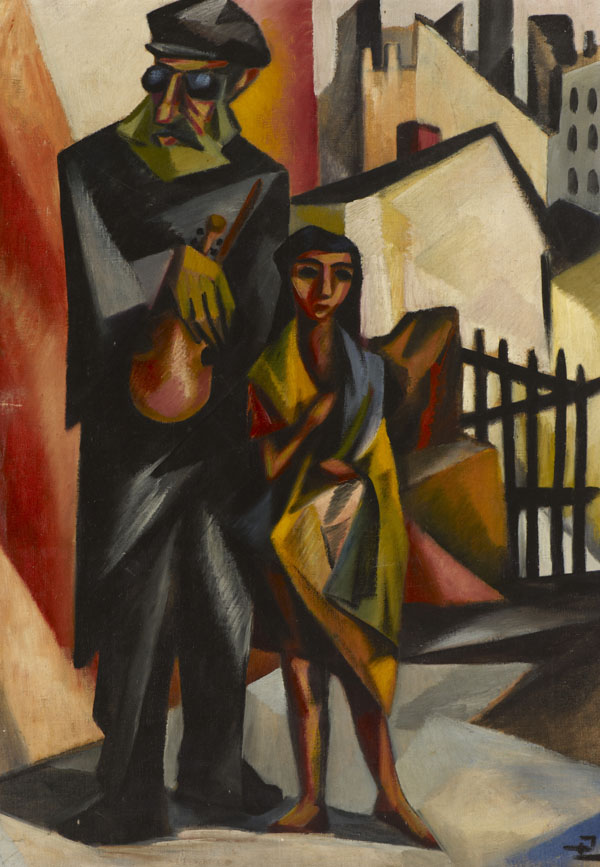
The Blind Fiddler
Artist information
Name Isaac Lichtenstein (1889-1981)
Other name Yisroel Likhtenshteyn, Israel Lichtenstein, Icchok Lichtenstein, Izrael Lichtenstein
Born Łódź, Poland
Died New York, USA
Find more work in the collection by this artist
Find out more about this artist
Isaac Lichtenstein was born into a Jewish family in Łódź, Poland in 1889 and studied art at the Academy in Krakow. As a young man, he travelled widely, going to Paris at the turn of the twentieth century, where he was among the loose group of émigré artists, mainly of Eastern-European Jewish descent, living and working together at the collection of La Ruche (The Beehive) studios in Montparnasse and known as the École de Paris or School of Paris. Together with Pinchus Krémègne, Henri Epstein, Leo Koenig, Marek Szwarc and Leon Indenbaum, Lichtenstein was one of the artists behind the publication of ‘Machmadim’ (Precious Ones), a textless Jewish art journal that was first published in 1912. Shortly after the outbreak of the First World War, Lichtenstein arrived in London together with Lazar Berson, who in 1915 founded Ben Uri, with Lichtenstein as a founder member. He is thought to have lived in America for much of the war, volunteering in 1918 to join the Jewish Legion and serving in Palestine. In 1920 Lichtenstein was briefly in London, where he was again in contact with Ben Uri, designing its second logo (Berson having departed in 1916) and giving a talk to the Society in the same year. In 1927 his work was included in the important exhibition of Jewish art and antiquities at the Whitechapel Art Gallery.
After the war, Lichtenstein moved between London, Poland, Paris, and America, where he spent most of his life, reviving the Machmadim Publishing House devoted to the production of artistic Yiddish books. In 1925 he had an exhibition in Vilnius, comprising more than 100 works grouped in three sections: oil paintings, watercolours and drawings, and scenic projects, also providing a foreword in Yiddish for the accompanying catalogue ('Yidishe kunst-gezelshaft in Vilne Oysshtelung fun di gezamelte verk fun Yitskhok Likhtenshteyn'). In the Ben Uri's 1930 catalogue and survey of activities, Lichtenstein was described as ‘a gifted colourist and keen student of Jewish art, [who] has, during his residence in London, rendered great services to the Ben Uri by professional advice and also by his interesting lectures on art and artists’. In June 1931 the Ben Uri Jewish Art & Literary Society mounted an Exhibition of Paintings and Dry Points by Isaac Lichtenstein at 63 Mansell Street in Aldgate (it was noted in the AGM minutes for 1931 that this ‘had not been a financial success for the artist concerned’). His work was included in numerous group exhibitions at Ben Uri including the Opening of the Ben Uri Jewish Art Gallery and an Exhibition of Works by Jewish Artists at Woburn House in 1934, an ‘Exhibition of Jewish Art’, arranged by the Ben Uri Art Gallery at the North Western Reform Synagogue in 1948, and a selection of works from the Ben Uri at the Russell-Cotes Gallery, Bournemouth in 1970. A monograph of his work with a text by Simon L. Millner was published by Machmadim Art Editions in New York in 1949. Isaac Lichtenstein died in New York in 1981.
Object Details
Date 1924
Object type painting
Medium oil on canvas
Materials and techniques oil (medium) canvas (support)
Unframed 89 x 63 cm
Framed 95 x 70 cm
Signed (verso): Lichtenstein 1924
Acquisition purchased 1925
Accession number 1987-220
Display status not on display
The Blind Fiddler combines traditional folk iconography with an angular style clearly influenced by Cubism, revealing the importance of Lichtenstein’s experience as part of the École de Paris. The fiddler (a popular motif in the work of Chagall) is here paired with a child, and stands in front of a colourful urban cityscape, which recalls the Orphism of Sonia and Robert Delaunay.
Keywords
blind | child | Cubism | fiddler | genre scene | musical instrument | musician | painting
Selected exhibition history
1925
Official Opening at Great Russell Street
Ben-Uri Jewish Art Society Gallery and Club
1927
Exhibition of Jewish Art and Antiquities
Whitechapel Art Gallery
1930
Mansell Street Gallery Opening: Catalogue and Survey of Activities
Jewish Art and Literary Society Ben-Uri
1945
Exhibition of Paintings by A. A Wolmark (Konstam Collection), Dobrinsky Paris, and a selection of work from the Ben Uri Collection
Ben Uri Art Gallery
1946
Selections from the Ben Uri Permanent Collection of Paintings, Sculpture & Drawings
Ben Uri Art Gallery
1948
Exhibition of Jewish Art
North Western Reform Synagogue
1954
Exhibition of Jewish Art
Hove Museum of Art
1960
Selections from the Permanent Collection
Ben Uri Art Gallery
1970
Paintings from the Ben Uri Art Gallery
Russell-Cotes Art Gallery and Museum
1980
Exhibition of Selected Works from the Permanent Collection of the Ben Uri Art Gallery
Ben Uri Gallery
1990
Ben Uri Highlights: Key Works and Figures
Ben Uri Art Society
2009
Homeless & Hidden 1: World Class Collection Homeless & Hidden
Ben Uri Gallery
2012
Chaim Soutine and his Contemporaries - from Russia to Paris and School of London works from the Ben Uri Collection
Ben Uri Gallery
2015
Arts in Harmony: An Art Gallery's Musical Heritage
Museum of Music, Royal College of Music
2017
Art Out of the Bloodlands: A Century of Polish Artists in Britain
Ben Uri Gallery
Literature
Rachel Dickson and Sarah MacDougall, eds., Ben Uri: 100 Years in London - Art, Identity, Migration (London: Ben Uri Gallery, 2015), p. 71 (illus.); Rachel Dickson, ed., From Adler to Zuławski: A Century of Polish Artists in Britain (London: Ben Uri Research Unit, 2020), p. 47 (illus.); Oil Paintings in Public Ownership in Camden (London: The Public Catalogue Foundation, 2013), p.27 (illus.); Sarah MacDougall ed., Soutine and his Contemporaries - from Russia to Paris (London: Ben Uri Gallery, 2012) p. 28; Walter Schwab and Julia Weiner, eds., Jewish Artists: the Ben Uri Collection - Paintings, Drawings, Prints and Sculpture (London: Ben Uri Art Society in association with Lund Humphries Publishers Ltd, 1994), p. 69.
Hover mouse cursor over image to zoom (you can also use the mouse wheel).