Ben Uri Pre-Eminent Collection

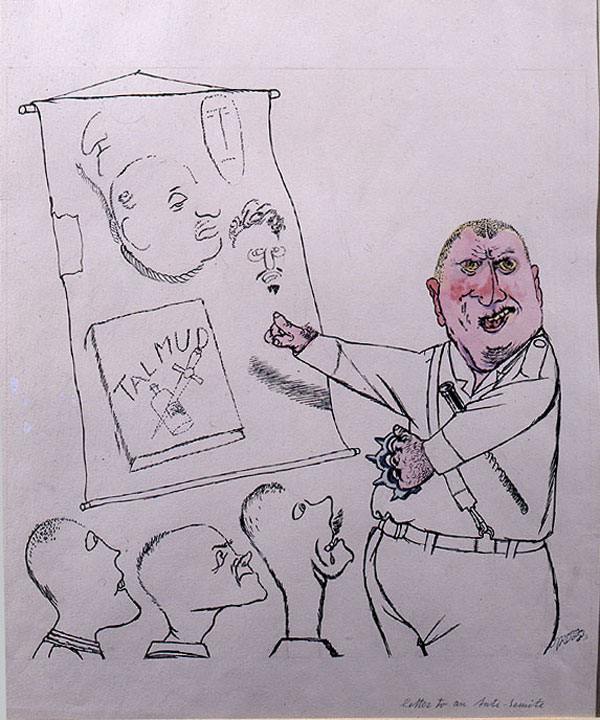
The Lecture (aka Letter to an Anti-Semite)
Artist information
Other name Georg Ehrenfried Groß
Born Berlin, Germany
Died Berlin, Germany
Find more work in the collection by this artist
Find out more about this artist
George Grosz (né Georg Ehrenfried Groß) was born in 1893 in Berlin, Germany. After expulsion from school, he trained at the Dresden Academy and later at the school of the Museum of Decorative Arts in Berlin (under Emil Orlik); he was greatly influenced by graphic artists including William Hogarth and Honoré Daumier and by popular art forms including graffiti. From 1916 he began to paint in oils and his lithographs featured regularly in books and magazines including ‘Ulk’. He served twice during the First World War (the first time as a volunteer) and was twice discharged for medical reasons. This experience sharpened his political conscience resulting in a series of bitingly satirical works that were particularly critical of militarism, corruption and hypocrisy and, as a mark of disrespect for German militarism, he Americanised his name (along with John Heartfield) in 1917 and joined the Sparticist uprising in 1918. Between 1917 and 1920 Grosz was a prominent member of the Dada movement in Berlin and also became the leading exponent of the Neue Sachlichkeit (New Objectivity) movement. He held his first solo exhibition in Munich in 1920 and his first retrospective in Brussels in 1932.
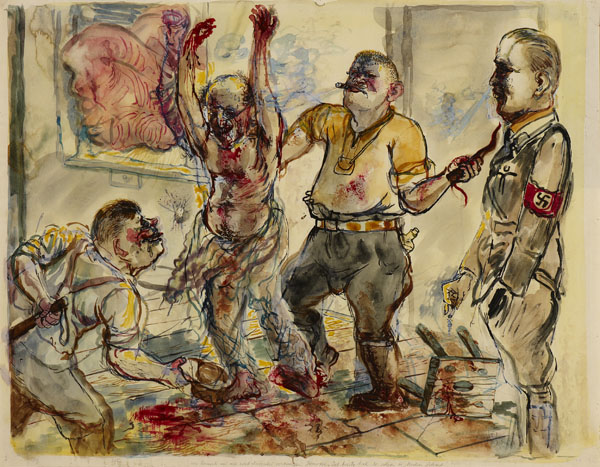
In 1933, only days before Hitler’s accession to the Chancellorship of Germany, Grosz moved to New York to avoid persecution under the Nazi regime and to take up the offer of a teaching post at the Art Students League of New York. In his absence, he was stripped of his German citizenship, 285 of his works were confiscated from public collections and many, together with a number of his books and portfolios, were destroyed. In New York he produced a hard-hitting series of works criticising the Nazi regime including The Interrogation and The Lecture (both Ben Uri Collection), featuring his friend the Jewish Communist and writer Erich Mühsam, tortured and murdered by the Nazis in Orianeburg Concentration Camp. In 1937 Grosz’s work was included, in his absence, in the infamous ‘Degenerate Art’ exhibition that opened in Munich before touring throughout Germany and Austria; the following year, he was also represented in the Exhibition of Twentieth Century German Art mounted at the New Burlington Galleries in London, as a riposte to the Nazi show, although later he largely abandoned his satirical work for landscapes and still-lifes.
In 1938 Grosz became a naturalised American citizen and published his autobiography, 'A Little Yes and a Big No' in New York in 1946, but, disillusioned with the ‘American Dream’, he returned to postwar Berlin in 1959. Georg Grosz died in Berlin, Germany, shortly after his return on 6 July 1959, after falling down the stairs. His work is represented in the UK in the Ben Uri Collection, the Fitzwilliam Museum and Tate, as well as in many international museum collections.
Object Details
Date 1935
Object type drawing
Medium pen and ink and watercolour on paper
Materials and techniques ink | pen (medium) drawing (technique) paper (support)
Unframed 55 x 45 cm
Framed 82.5 x 72 cm
Signed (with ink, lower right) Grosz / titled (with pencil, lower right) Letter to an Anti-Semite
Acquisition presented by Sally, Richard and Andrew Kalman in honour of their late father Andras Kalman 2013
Accession number 2013-03
Display status not on display
In 1933, only days before Hitler’s accession to the Chancellorship of Germany, Grosz moved to New York to avoid persecution and to take up the offer of a teaching post. In his absence, he was stripped of his German citizenship and a number of his books and portfolios were destroyed. The lecture is one of two works in the Ben Uri Collection that commemorate the brutal death of Grosz’s friend, the radical Jewish writer and anarchist Erich Mühsam (1878–1934), a long-time critic of successive German political regimes, who was tortured and murdered in Oranienburg concentration camp. To the National Socialists, Mühsam, as a Jew, was the definition of everything worth hating – even though, according, to Grosz, he was ‘actually a completely harmless, idealistic anarchist’. Grosz shows only Mühsam’s head, brutally shorn and branded and with a noose around his neck (Mühsam’s wife was informed that he had hanged himself); beneath him a copy of the Talmud has been speared by a dagger. A thuggish officer grasping a knuckle-duster, his face red and contorted with rage, points to the image on a lecture board while his audience slavers with anticipation or appreciation. Both these works are part of a larger disturbing series commemorating the writer created in America although Grosz later largely abandoned his satirical work for landscapes and still-lifes. In 1937 Grosz’s work was included, in his absence, in the infamous 1937 ‘Degenerate Art’ exhibition that opened in Munich before touring throughout Germany and Austria.
This work (together with The Interrogation) was unveiled at a special ceremony at Ben Uri in Boundary Road, St John’s Wood, London on 30 January 2013. This marked the 80th anniversary of the day on which Adolf Hitler succeeded to the Chancellorship of Germany in 1933 and the donation to the museum by Sally, Richard and Andrew Kalman in memory of their late father Andras Kalman (1919–2007). He was a Hungarian émigré, who came to the UK to study in 1939 and later founded the Crane Kalman Gallery, and whose own immediate family perished in the Holocaust.
Keywords
caricature | Nazism | painting | school
Selected exhibition history
2015
Out of Chaos – Ben Uri: 100 Years in London
Somerset House
2017
Graphic Witness
Drawing Room
2018
Exodus: masterworks from the Ben Uri Collection
Bushey Museum
2018
Acquisitions and Long-Term Loan Highlights Since 2001
Ben Uri Gallery
2019
Brave New Visions: The Emigres Who Transformed the British Art World
Sothebys
2024
Cosmopolis: The Impact of Refugee Art Dealers in London
Ben Uri Gallery
2025
Ben Uri 110/25: From Local to Global
Ben Uri Gallery
Literature
Sarah MacDougall (foreword), Important Additions to the Collection since 2000 (London: Ben Uri Gallery and Museum, 2025), p. 7, illus., p. 50; Rachel Dickson and Sarah MacDougall, eds., Out of Chaos: Ben Uri - 100 Years in London (London: Ben Uri Gallery, 2015) pp. 80-81, illus.
Hover mouse cursor over image to zoom (you can also use the mouse wheel).
To license this image contact Bridgeman images
Related works
Interrogation
by George Grosz