Ben Uri Collection

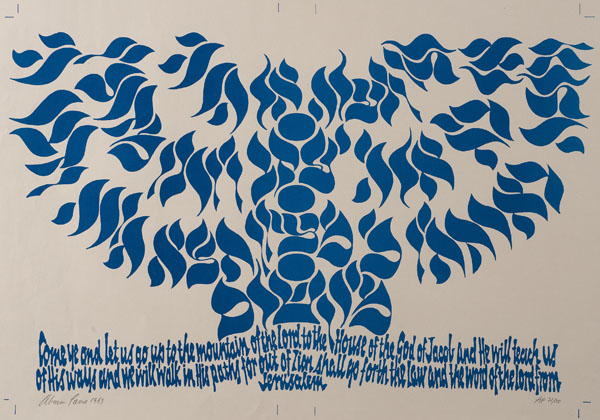
Isaiah Chapter 2 Verse 3
Artist information
Other name Abraham Gamse
Born London, England
Died London, England
Find more work in the collection by this artist
Find out more about this artist
Abram Games (originally Abraham Gamse) was born into a Jewish immigrant family in London, England on 29 July 1914. His father was a photographer, originating from Latvia, and taught him to hand-render his images. Games briefly attended St. Martin's School of Art, but, dissatisfied with the teaching, left after only two terms in 1930. In 1935, at the age of 22, he won first prize in a poster design competition for London County Council and afterwards, established himself as a freelance poster designer gaining commissions from London Transport and the General Post Office, among others. He joined the infantry as a private in 1940 and after designing a recruiting poster for the Royal Armoured Corps in 1941, was appointed official war poster designer (1942–6) with Frank Newbould as his assistant. He created over a hundred iconic and educational and instructional wartime posters; many celebrated, others controversial: his set of three posters for the 'Your Britain … fight for it now' campaign was considered too political; his recruiting poster for the Auxiliary Training Service (1941), ‘too glamorous’ (withdrawn after questions in Parliament).
In 1945 Games married Marianne Salfeld (1919–1988), a textile designer born in Mainz, Germany, and set up his commercial design practice in the family home in north-west London. Postwar, he continued his freelance commercial work for employers including London Transport, BOAC, and the Financial Times, coining the phrase 'maximum meaning, minimum means', to describe his approach to design. He also produced posters for Jewish charities, such as the arresting 'Give Clothing for Liberated Jewry' poster for the World Jewish Relief organisation CBF. In 1948 Games won a competition to design stamps for the 1948 Olympics, and three years later, created the iconic 'Festival Star' image for the Festival of Britain for which he designed a mural, catalogue covers, a stamp, a plaque, and was commissioned by London Transport to design a travel information panel poster. Games was also a key organiser of Ben Uri's corresponding 1951 Festival of Britain Anglo-Jewish exhibition. He also created logos and symbols including the first insignia for BBC television in 1953 and the Queen's Award to Industry (1965). In 1957 he recieved an OBE and, in 1959, was appointed Royal Designer for Industry (RDI). He was a visiting lecturer at the Royal College of Art, London (1946–53), and in 1968 the United Nations Industrial Development Organization appointed him as a consultant at the Bezalel School of Art in Jerusalem.
In 1966 Games used his trademark style to create a 50th anniversary graphic for Ben Uri, also designing a Ben Uri logo which was used on publications and as a letterhead from the late 1970s to the 1990s; four major Ben Uri exhibitions were held of his designs. In recognition of a lifetime's achievement Games was awarded the Designers and Art Directors Association President's Award in 1991. Abram Games died in London, England on 26 August 1996. His work is held in collections including the Ben Uri Collection, the Imperial War Museum, London, and the V&A.
Object Details
Date 1969
Object type print
Medium screenprint on paper
Materials and techniques ink (medium) screen printing (technique) paper (support)
Unframed 38 x 57.2 cm
Signed and dated (lower left): Abram Games 1969
Acquisition presented by the artist
Accession number 2012-54
Display status not on display
Keywords
bible | blue | calligraphy | Hebrew | judaic | Old Testament | religious
Hover mouse cursor over image to zoom (you can also use the mouse wheel).