Ben Uri Collection

Max Heiliger
Artist information
Name Reginald Case (1937-2009)
Born New York, USA
Died Florida, USA
Find more work in the collection by this artist
Find out more about this artist
Reginald Case was born in Watertown, NY on 23 December 1937, and graduated from the local High School in 1955. He studied science at the State University of New York at Buffalo, then took an MA in Fine Art at Boston University. Afterwards he taught at Phillips Exeter Academy and Norfolk State College. During this period, he completed a series of large still-life paintings, before turning to collage.
His best-known work, from the 1980s-90s, plays with Hollywood iconographic assemblage, collage and construction, fusing early influences in film and photography, from Rudolph Valentino to Fred Astaire and Humphrey Bogart, and culminating in a series of objects focusing on Marilyn Monroe. In 'Marilyn Money’, he substitutes the film star’s image for American currency. In other works exploring the roots of American history and popular culture, he showcases Barbie and Madonna.
Case’s museum exhibitions include the Everson Museum of Art, Munson-Williams-Proctor Arts Institute, Reading Museum and the Virginia Museum of Fine Arts. Reginald Case died on 24 April 2009. His work is represented in many private and public collections, including the Museum of Fine Arts, the Smithsonian American Art Museum and The British Museum.
Object Details
Date 1978
Object type photograph
Medium photomontage on paper
Materials and techniques photomontage (technique) paper (support)
Unframed 26 x 20 cm
Signed (lower left): 'Reginald Case'
Acquisition presented by the artist 2008
Accession number 2009-17
Display status not on display
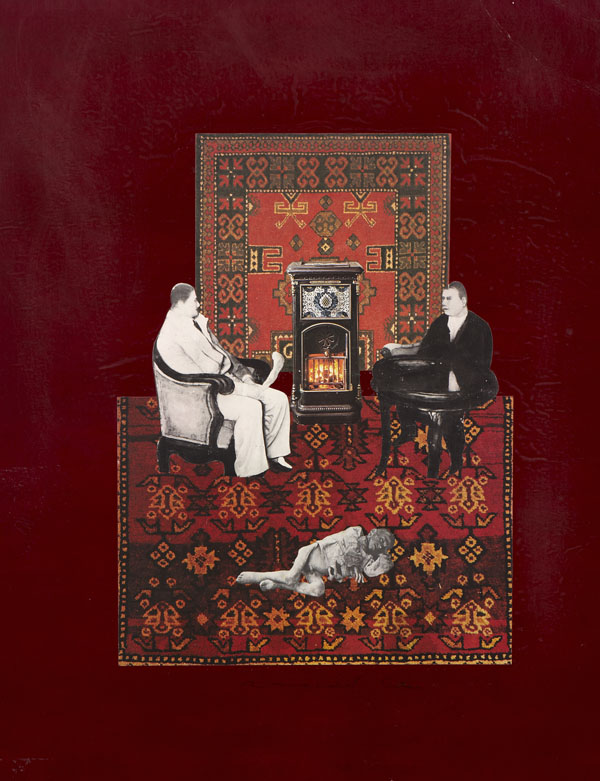
This work and its companion, 'Nazi Berlin Cabaret', are part of a 1978 series on the theme of holocaust, including a piece called ‘Sonderbehandling (special treatment, Nazi bureaucratic term for killing prisoners)’, displayed at the V&A. As a child growing up in the 1940s in the United States, Case was disturbed by the postwar revelations of the horror that had taken place in Europe and began to exorcise his childhood demons in a series of collages on this theme.
Max Heiliger was a fictional name created during the Nazi era under an agreement between Reichsbank president Walther Funk and Heinrich Himmler, to establish bank accounts under a false identity to launder valuables stolen from Nazi concentration and extermination camp victims. It included banknotes, jewellery and gold from teeth, wedding rings and spectacle frames. The name "Heiliger" (saint) derives from the word “heilig” (holy). In this chilling work, two comfortable bureaucrats, cosily installed by the fire, are juxtaposed with the image of a concentration camp victim on the rug in front of them.
Hover mouse cursor over image to zoom (you can also use the mouse wheel).