Ben Uri Collection

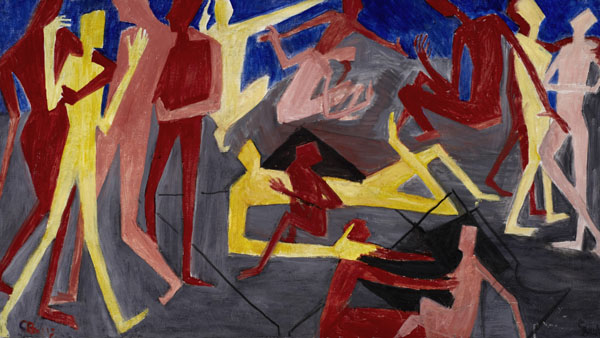
Untitled (Vorticist Figures)
Artist information
Name Clare Winsten (1892-1989)
Other name Clara Birnberg, C B Winsten
Born Romania
Died Abberton near Colchester, England
Find more work in the collection by this artist
Find out more about this artist
Painter and sculptor Clare Winsten (née Clara Birnberg) was born to Galician Jewish parents in Romania on 10 August 1892, and later immigrated to England with her family c. 1902. She was a member of the Women’s Freedom League, as well as the only girl among the so-called 'Whitechapel boys', a group of artists and poets linked through the East End Jewish community centred around Whitechapel and Stepney. The latter included her future husband Stephen Winsten (formerly Samuel ‘Simy’ Weinstein), the poet/publisher John ‘Jimmy’ Rodker, and Joseph Leftwich (who coined the name), as well as the painter/poet Isaac Rosenberg and painters Mark Gertler and David Bomberg, whom she studied alongside at the Slade School of Fine Art. Her work was included in the ‘Jewish Section’ co-curated by Bomberg and Jacob Epstein as part of the Whitechapel Art Gallery’s ‘Twentieth-Century Art: A Review of Modern Movements’ in 1914, although she also showed more innovative work outside this section. Bomberg, with whom she afterwards fell out, painted her and she and Rosenberg created reciprocal portraits.
During the First World War, the Winstens, were Pacifists, Conscientious Objectors and members of the 'No Conscription' fellowship. They married in 1916 and in November of the same year, Stephen Winsten undertook the first of three consecutive terms of imprisonment for his beliefs. Postwar both worked on humanitarian causes and became Quaker Humanists. Stephen Winsten published a book of poems ‘Chains’ (1920), for which Clare produced a number of (unpublished) illustrations, based on his prison experience. Clare Winsten's output included drawings (including a sequence on Oscar Wilde's 'Ballad of Reading Gaol'), paintings and sculpture including a commission for Toynbee Hall, and several of George Bernard Shaw, their neighbour at Ayot St Lawrence, Hertfordshire, in the late 1940s, about whom Stephen wrote a number of books.
Clare Winsten died in Abberton, near Colchester, England in 1989. Her work is held in UK collections including the Ben Uri Collection, the British Museum, the National Portrait Gallery, UCL and the Harry Ransom Humanities Research Centre, University of Texas at Austin. A gift left to UCL in Winsten’s will established her eponymous prize for female artists in order to support them in their early career development.
Object Details
Date c. 1911-12
Object type painting
Medium oil on canvas
Materials and techniques oil (medium) painting (technique) canvas (support)
Unframed 45.8 x 81.4 cm
Framed 53.3 x 89.2 x 8.3 cm
Signed (lower left): 'CB' [date illegible]
Acquisition presented by Liss Fine Art
Accession number 2008-4
Display status Not on display
Although less finely executed than its more finished companion piece, Untitled Figure Study (1912, oil on board, Liss Fine Art), this composition with its bold palette and flattened, pared down figures, undoubtedly dates to Winsten's later period at the Slade School of Fine Art (1910-12) and a period of modernist experimentation in her work, signalling her rapid modernist trajectory in this period. The trianglular heads and crossed limbs contained within a rudimentary hand-drawn grid relate not only to her more finished work (Liss Fine Art) but that of her contemporaneous student David Bomberg, who also used the device of figures emerging from a grid several times in contemporaneous works including 'Island of Joy' (c. 1912), 'Vision of Ezekiel' (1912), and, most famously, 'The Mud Bath (1914, Tate). The two artists knew each other as students at the Slade and Bomberg included her work in the 'Jewish Section' of the exhibition 'Twentieth-century Art: A Review of Modern Movements' at the Whitechapel Art Gallery in 1914, although she also showed work outside this section. Winsten reworked the motif of severely simplified, actively engaged or struggling forms in several increasingly complex contemporaneous exhibitions before later abandoning these early experiments and turning first to more figurative, and then in her last years, more abstract forms.
Keywords
Selected exhibition history
2023
Art, Identity, Migration - Ben Uri at the London Art Fair
Business Design Centre
2023
Futurliberty
Museo del Novecento
2025
Ben Uri 110/25: From Local to Global
Ben Uri Gallery
Literature
Oil Paintings in Public Ownership in Camden (London: The Public Catalogue Foundation, 2013) p. 44.
Hover mouse cursor over image to zoom (you can also use the mouse wheel).