Ben Uri collection
Work by Ghisha Koenig
Biography
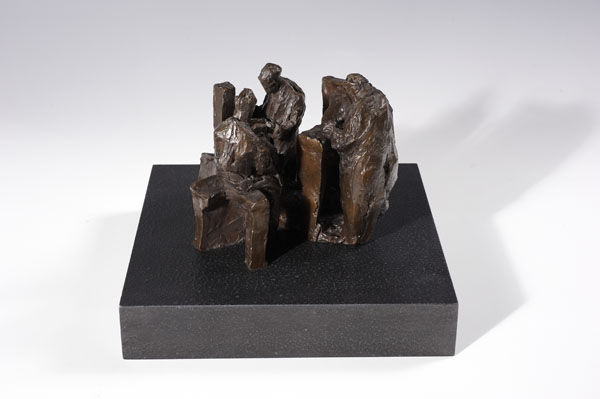
Sculptor and draughtswoman Ghisha Koenig was born in Kensington, London, England on 8 December 1921, the daughter of the poet, writer, art critic and distinguished Yiddishist Leo Koenig (1889-1970), a Russian-Jewish immigrant and one of Ben Uri’s founders. She grew up in a literary and artistic household and David Bomberg and Josef Herman were among her parents' circle. In 1939 Koenig won a scholarship to the Hornsey School of Art, leaving in 1942 to begin four years of war service in the Army. Afterwards she studied under Henry Moore at Chelsea School of Art (1946-48) and under F. E. McWilliam at the Slade School of Fine Art (1948-49). She created small scale realist bronzes and terracottas in high relief, staining the latter ‘with dark ink prior to burnishing them to restore the clay’s richness’ (David Buckman). Her subject was the human condition and Charles S. Spencer observed that 'her work reveals a fine, sturdy talent and an unusual preoccupation with ordinary people in their working habits' (Charles S. Spencer, Ghisha Koenig - Sculptress in a Factory, Art Quarterly, Vol. 14, spring 1966). She focused particularly on factory workers, whom she observed over 40 years, commenting that ‘after Hitler, the dignity of man had to be re-established’. Although observing them with dignity and endowing them with individuality, she nonetheless maintained a personal detachment from her subjects. She made only one piece referencing her Jewish background, 'Ezekiel: survival (1956)', a bronze in memory of those who perished in the Holocaust.
Koenig held solo exhibitions at the Grosvenor Gallery, London (1966), the Serpentine Gallery (and tour, 1986), with an accompanying exhibition of her sketches at the Boundary Gallery, north London (also 1986). She also participated in a number of mixed exhibitions including the Tercentenary Exhibition of Contemporary Anglo-Jewish Artists (Ben Uri Gallery, 1956), Jewish Artists in England (Whitechapel Art Gallery, 1956), Ben Uri 50 Fiftieth Anniversary Special Exhibition (Ben Uri Gallery, 1966) and also showed with the Artists’ International Association (AIA) and at the Sculptural Biennale, among others. In 1978 she won the Arts Council Award for a solo show at Galerie Husstege, Holland. Her public commissions include pieces for the Ministry of Work (1950), the Festival of Britain (1951), St. John the Divine (1961) and Dalton House School, Sevenoaks, Kent (1986). In 1993 the writer Sue Townsend contributed a piece on Koenig to eds., Collins, Judith and Lindner, Elsbeth, Writing on the Wall: Women Writers on Women Artists (London: Weidenfeld & Nicolson, 1993), p. 141.
Ghisha Koenig died in London, England on 15 October 1993. Her work is held in UK collections including the Ben Uri Collection; the Henry Moore Institute, Leeds (which also holds her sketchbooks and press cuttings); Homerton College, Cambridge; the City Art Gallery, Manchester; the Museum of Labour History, Manchester, the Graves Art Gallery, Sheffield; the City Art Gallery, Stoke-on-Trent, Tate, and the Women's Art Collection, Murray Edwards College, Cambridge, as well as Middleheim Museum in Belgium. A memorial show was held at the Boundary Gallery, London in 1994, her work was posthumously included in The Ben Uri Story from Art Society to Museum at Philips (2001), and the Henry Moore Institute, Leeds held a retrospective, Ghisha Koenig: Machines Restrict their Movement, in 2017.
Search Ben Uri archive for more information about Ghisha Koenig
Artist keywords
AIA (Artists' International Association) | Chelsea School of Art | Henry Moore | Hornsey School of Art | realism | sculptor | Slade School of Fine Art
1 work/s by this artist from the collection are shown below. For a more detailed record and image please click on the link.