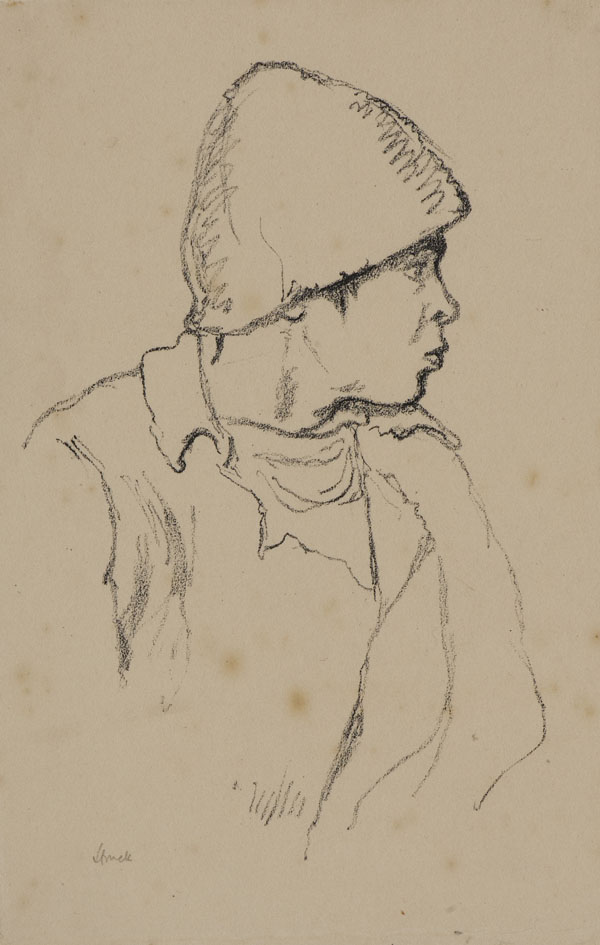
Ben Uri collection
Work by Hermann Struck
Biography
Etcher Hermann Struck (Chaïm Aaron ben David) was born into a Jewish family in Berlin, Germany on 6 March 1876. He studied at the Berlin Academy of Fine Arts but upon graduation in 1899 was banned from teaching there because of his Jewish origins. After meeting, in 1900, leading Dutch master of etching Jozef Israëls, Struck became a celebrated etcher himself, creating commissioned portraits of leading cultural figures including Ibsen, Nietzsche, Freud, Einstein and Oscar Wilde, as well as the Zionist leader Theodor Herzl. Struck was also a fervent Zionist and Jewish activist and exhibited works at the Fifth Zionist Congress. In 1904 he became a member of the progressive artists’ movement the Berlin Secession.
Struck was one very few German to be elected a memebr of the Royal Society of Painters, Etchers and Engravers in 1902 and in 1908 he published his seminal book, Die Kunst des Radierens (The Art of Etching), combining theory and practical instruction. In 1911 the author Karl Schwarz published Das Graphische Werk von Hermann Struck in Berlin. Struck's students included Marc Chagall, Lovis Corinth, Jacob Steinhardt, Lesser Ury and Max Liebermann. During the First World War, he served in the army as a military artist and was awarded the Iron Cross. In 1922 he immigrated to Palestine and taught at the Bezalel School, also helping to establish the Tel Aviv Museum of Art but continued to return to Berlin every summer until the Nazis’ accession to power. He died in Haifa, then in Mandatory Palestine, in 1944. An exhibition was held at Ben Uri the same year.
In the UK Hermann Struck's work is held in the Ben Uri Collection, as well as in many international public collections.
Search Ben Uri archive for more information about Hermann Struck
Artist keywords
Berlin Secession | Bezalel School of Art | etcher | Germany | Jerusalem | Jewish | Kunstgewerbeschule Berlin | Zionism
1 work/s by this artist from the collection are shown below. For a more detailed record and image please click on the link.