Ben Uri collection
Work by Henry Sanders
Biography
Painter Henry Sanders (Helmuth Saloman) was born into a Jewish family in Dresden, Germany in 1918. Following Hitler's accession to the German Chancellorship in 1933, he left for Holland, where he spent two years. In 1935 he moved to England, where he studied at Hornsey College of Art from 1935–39. During the Second World War, Sanders was interned as an ‘enemy alien’ in a Commonwealth camp in Canada, where he drew prodigiously. Afterwards, he returned to England, and to Hornsey, studying under Russell Reave and John Moody.
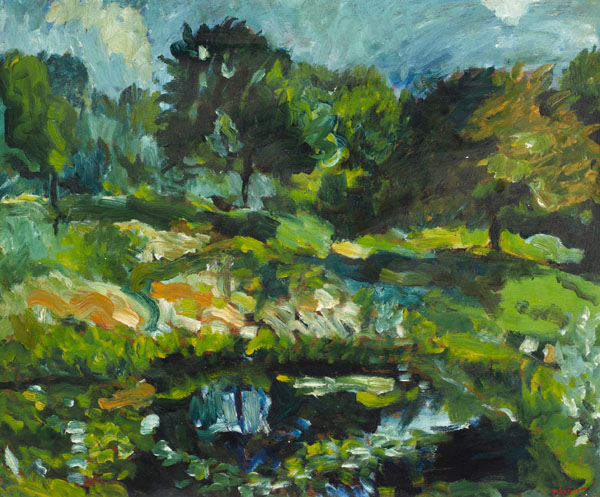
Postwar he travelled widely in France, Italy, the Netherlands and Spain and exhibited regularly at galleries in London including the Redfern Gallery and émigré art dealers Roland, Browse & Delbanco, as well as with the artists' exhibiting society and The London Group. In 1949–51 he served in the Studio Group Committee at Ben Uri Gallery, where he was a frequent exhibitor, participating annually in group exhibitions in 1950–59, 1965, 1967, 1969–75, and 1980 (twice), and posthumously, 1983, 1985, 2011 and 2018. He had solo exhibitions at the Obelisk Gallery, London; in Newcastle-upon-Tyne; and at Ben Uri Gallery in 1954, 1957 and 1959, as well as a joint exhibition with Grete Marks in 1970. Primarily a painter, he also made lithographs and linocuts, but specialised in breezy landscapes in oil or gouache, notable for the vigour of their execution and rich palette, as well as studies of animals, and occasionally nudes. In a review of his 1954 exhibition at Ben Uri Gallery, the Jewish Quarterly critic Michael Bullock praised the artist's work for a quality of 'expressiveness', concluding 'Whatever Sanders produces is invested with an irrepressible vitality [...] Sanders never ceases to scan the outer world with an unfailing eye for the vitally alive and he possesses the capacity to portray living things in all their concrete immediacy [...] The refreshing directness of Sanders work is something to be grateful for' (Jewish Quarterly, Vol. 2, no. 2, Autumn 1954). Earlier the same year, in the Ben Uri studio group show, Sanders' work was singled out for his 'special interest in animals [...] His ‘Tigers’ have a richness and glow altogether outstanding, and the landscapes flanking this work are equally enchanting in their ease of execution’ (A.K.S., Jewish Chronicle, March 1954, p. 28). Fellow artist Stephen Bone, reviewing Sanders’ solo show in 1957, considered that his ‘Expressionist style owes something to Kokoschka - or perhaps Soutine’ and that he was ‘best on a small scale' (Stephen Bone, Manchester Guardian, 20 September 1957), while another critic, reviewing the same show, called Sanders ‘a hit-or-miss artist’ but concluded that, ‘I would a thousand times rather have him than a milk-and-water artist who will never offend and never stir’ (F.G.S, Jewish Chronicle, 20 September 1957).
In 1960 Sanders opened Queenswood Galleries with his wife, located at 214 Archway Road in north London, where he exhibited his own work and that of other contemporary artists, among them many Jewish émigré painters, including Horace Brodzky, Frederick Feigl, Paul Hamann and Ada Flatto.
Henry Sanders died in London, England in 1982. Ben Uri held a joint memorial exhibition in his honour, together with fellow Hitler émigrés Jack Bilbo and Lottie Reizenstein, in 1983, describing Sanders' death as 'untimely' and concluding that he should have received greater recognition during his lifetime. In the UK Sanders’ work is held in the Ben Uri Collection.
Search Ben Uri archive for more information about Henry Sanders
Artist keywords
Ben Uri member | Germany | Hitler émigré | Hornsey College of Art | internee | internment | lithographer | painter
2 work/s by this artist from the collection are shown below. For a more detailed record and image please click on the link.